
Blog
Startup Booted Financial Modeling: The Ultimate 2026 Revenue-First Framework for Sustainable Growth

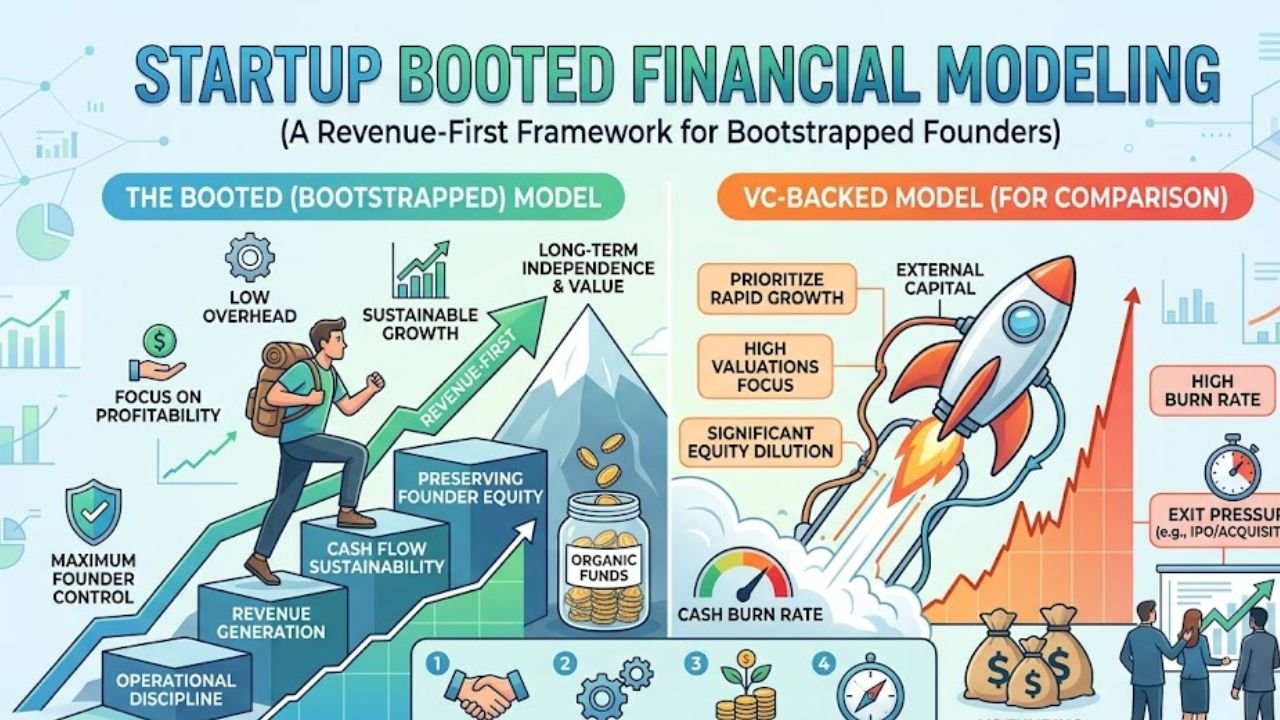
Startup booted financial modeling is changing how founders build companies in 2026. Instead of chasing funding rounds and high valuations, many entrepreneurs are now focusing on revenue-first growth. This approach is practical, disciplined, and focused on long-term survival. It helps founders stay in control, avoid unnecessary risks, and build businesses that can thrive without outside capital. As markets become more competitive, this model is becoming the preferred path for sustainable success.
What Is Startup Booted Financial Modeling
Startup booted financial modeling, also known as bootstrapped financial modeling, is a framework where startups grow using their own revenue instead of external venture capital. The goal is simple. Build a business that earns money early, manages costs carefully, and becomes profitable as soon as possible. This model focuses on cash flow, operational discipline, and strong unit economics. It ensures that a company can survive without relying on investors.
Why Revenue-First Growth Matters for Modern Founders
In today’s startup ecosystem, revenue-first growth has become essential. Many founders have realized that rapid growth without profit can lead to failure. By focusing on customer-funded growth, businesses reduce risk and gain stability. Revenue validates demand, improves decision-making, and creates a strong foundation. This approach also allows founders to maintain full control of their company and avoid dilution of equity.
Booted vs VC-Backed Financial Modeling
Startup booted financial modeling is very different from traditional VC-backed planning. In a booted model, the focus is on profitability and sustainability. Every expense must justify itself. Growth happens at a steady pace based on available cash. In contrast, VC-backed models aim for rapid expansion and market dominance. They often involve high spending and aggressive hiring. While venture capital can accelerate growth, it also increases pressure and risk.
Core Philosophy Behind a Bootstrapped Financial Model
The core philosophy of this model revolves around discipline and efficiency. Founders rely on real revenue rather than projections. They focus on building a product that customers are willing to pay for from day one. Cash flow is treated as the lifeline of the business. The idea of becoming “Default Alive” is central, meaning the company can operate and grow without needing additional funding.
The Three Financial Statements Every Booted Startup Needs
A strong startup booted financial modeling system includes three key financial statements. The cash flow statement tracks money coming in and going out. The profit and loss statement shows whether the business is making a profit. The balance between these statements helps founders understand financial health. Together, they provide a clear picture of how the business is performing.
Why a 12–24 Month Cash Flow Forecast Is Essential
Cash flow forecasting is the most important part of this framework. A 12 to 24 month forecast allows founders to plan ahead and avoid financial surprises. It shows when money might run out and helps in making informed decisions. This forecast is not static. It must be updated regularly to reflect real performance. Accurate forecasting can prevent the common startup problem of running out of cash.
Understanding Profit and Loss in a Booted Model
The profit and loss statement helps founders track revenue and expenses. It separates fixed costs like salaries and rent from variable costs like marketing and processing fees. This clarity allows founders to control spending and improve margins. A healthy profit and loss statement is a sign of a sustainable business.
The Key Metrics Dashboard Founders Must Track
Startup booted financial modeling relies heavily on key metrics. Burn rate shows how quickly cash is being spent. Runway indicates how long the company can survive. Customer Acquisition Cost and Lifetime Value measure profitability per customer. Break-even point reveals when the business will cover all expenses. These metrics guide decisions and help maintain financial stability.
The 2026 Revenue-First Framework for Founders
The 2026 revenue-first framework has been shaped by experts like Tim Boniface. This framework emphasizes immediate revenue, operational discipline, and strategic planning. It moves away from the traditional “burn-to-scale” mindset. Instead, it encourages founders to focus on profitability from the beginning. This shift reflects the changing startup environment where efficiency matters more than rapid expansion.
The Replacement Cost Rule and True Profitability
One unique concept in startup booted financial modeling is the replacement cost rule. A business is only truly profitable if it can pay the founder a market-level salary. If the founder is working for free, the business is not sustainable. This rule ensures that profits are real and not dependent on unpaid labor.
Default Alive and Why It Matters in 2026
Default Alive is a critical concept in modern startups. It means the company can continue operating without needing external funding. This status provides security and flexibility. Founders can make long-term decisions without pressure from investors. In uncertain markets, being Default Alive is a major advantage.
The Four Stages of a Startup Booted Model
Startup booted financial modeling evolves through four stages. In the pre-revenue stage, the focus is on validating the idea and building a minimum viable product. During revenue validation, founders test pricing and refine their sales process. The sustainable growth stage involves reinvesting profits into high-return channels. Finally, the scaling stage focuses on automation and efficiency, often using AI tools.
Best Practices for Startup Booted Financial Modeling
Successful founders follow certain best practices. They use driver-based assumptions instead of guesses. They update their financial models every month. They plan for worst-case scenarios to stay prepared. They also manage expenses carefully by using step-function costing. These practices ensure that the business remains stable and adaptable.
Advanced 2026 Trends in Booted Financial Modeling
The latest trends in startup booted financial modeling include the use of AI and automation. Agentic AI systems can now handle complex financial tasks. They update dashboards, test scenarios, and provide insights in real time. There is also a shift toward usage-based pricing models. This aligns costs with actual usage and improves profitability.
The Best Finance Tech Stack for Booted Founders
Modern founders rely on advanced tools to manage their finances. Platforms like Finmark and Datarails simplify financial modeling. These tools replace manual spreadsheets and provide real-time insights. They help founders make faster and better decisions.
The Role of Technology in Financial Modeling History
The history of financial modeling cannot be ignored. Dan Bricklin revolutionized the field by creating the first electronic spreadsheet, VisiCalc. His innovation made financial modeling accessible to individuals. Today’s tools build on this foundation, adding automation and intelligence.
Famous Bootstrapped Companies That Prove the Model Works
Several companies have successfully used startup booted financial modeling. Mailchimp grew into a billion-dollar business without venture capital. Basecamp is another example of sustainable growth. Zoho has also achieved massive success while staying bootstrapped. These companies prove that this model can work at scale.
Pros and Cons of Startup Booted Financial Modeling
Startup booted financial modeling offers many advantages. Founders keep full ownership and control. They build strong financial discipline and reduce risk. The business becomes more resilient. However, there are challenges. Growth can be slower compared to VC-backed startups. Founders may face financial pressure and limited resources. Despite these challenges, many prefer this approach for its long-term benefits.
How Founders Can Build a Booted Model Step by Step
Building a booted model starts with defining the revenue structure. Founders must identify how money will be generated. Next, they map out all costs and categorize them. Then, they create a cash flow forecast to track financial health. Key metrics are added to monitor performance. Finally, the model is updated regularly based on real data. This step-by-step approach ensures accuracy and sustainability.
Conclusion
Startup booted financial modeling is more than just a financial strategy. It is a mindset focused on discipline, efficiency, and long-term success. In 2026, this approach is becoming the standard for founders who want to build strong, independent businesses. By focusing on revenue, managing cash flow, and using modern tools, startups can achieve sustainable growth without relying on external funding.
FAQs
What is startup booted financial modeling
Startup booted financial modeling is a framework where startups grow using their own revenue instead of external funding. It focuses on profitability, cash flow, and operational discipline.
How is startup booted financial modeling different from VC-backed modeling
The booted model focuses on sustainable growth and profitability, while VC-backed modeling prioritizes rapid scaling and market expansion.
Why is cash flow important in startup booted financial modeling
Cash flow is essential because it determines whether a startup can survive. Proper cash flow management helps avoid financial crises.
What are the most important metrics in startup booted financial modeling
Key metrics include burn rate, runway, customer acquisition cost, lifetime value, and break-even point. These metrics help measure financial health.
Can a startup succeed without venture capital
Yes, many companies like Mailchimp and Zoho have proven that startups can grow successfully without venture capital by using a revenue-first approach.


Modern dating culture and lifestyle media are filled with unique terms and metaphors to describe various aspects of romance, intimacy, and affection. From casual dating trends to sensory kissing styles, learning these terms helps readers better navigate romantic literature, relationship blogs, and online discussions.
One expression that frequently piques curiosity in romantic terminology guides is the snowball kiss.
What Does a Snowball Kiss Entail?
In lifestyle discussions and romance concepts, the term snowball kiss is used to describe a romantic exchange characterized by momentum, temperature contrast, or playful sharing between partners.
Here are the main ways the term is interpreted in modern romance guides:
1. The Building Momentum Concept
Just as a snowball grows larger and faster as it rolls down a hill, this style of kiss starts very soft, slow, and delicate, gradually building up into an intense, deeply passionate moment.
2. Temperature Contrast Play
In sensory romance context, it refers to incorporating cold elements—such as a chip of ice or cold beverage—passed gently during a warm kiss to create an invigorating sensory contrast.
3. Spontaneous & Playful Connection
It symbolizes a lighthearted, playful intimate gesture meant to break routine and bring a moment of fun, shared laughter into a relationship.
The Role of Playful Gestures in Relationships
Incorporating novel, playful gestures into a relationship offers several emotional benefits:
- Breaks Monotony: Trying playful or creative kissing techniques keeps romantic routines fresh and exciting.
- Enhances Connection: Lighthearted sensory experiences encourage partners to focus fully on the present moment together.
- Encourages Open Communication: Exploring fun dating terms together can make discussing romantic preferences easier and more comfortable.
To explore full context explanations, cultural references, and practical romantic insights, check out this detailed guide explaining what a Snowball Kiss Mean in today’s lifestyle vocabulary.
Conclusion
Understanding romantic jargon and expressive terminology adds depth to how we discuss human connection. Whether you come across it in modern romance fiction or lifestyle articles, the concept of a snowball kiss highlights the importance of creativity, warmth, and playfulness in romantic relationships!

As global communication and digital culture bring people closer, picking up words and slang from different languages has become second nature. Spanish is one of the most widely spoken languages in the world, and its everyday vocabulary is rich with cultural nuances, affectionate terms, and casual slang.
One word that frequently appears in Spanish movies, songs, social media captions, and casual conversations is Viejo (or its feminine form, Vieja). While its direct translation is simple, its actual meaning often changes depending on who is speaking and how it is used.
The Literal Translation vs. Cultural Meaning
At its core, Viejo is a Spanish adjective that literally translates to “old” in English. It can be used to describe non-living objects, such as an old car (un carro viejo) or an old building (un edificio viejo).
However, when applied to people or used in daily conversations, Viejo takes on a variety of cultural meanings:
1. A Term of Endearment for Fathers or Husbands
In many Latin American countries, it is extremely common for people to refer to their father warmly as “mi viejo” (my old man). Similarly, spouses might affectionately call each other “viejo” or “vieja” in casual home settings.
2. Calling a Close Friend (“Che Viejo” / “Oye Viejo”)
In informal settings—especially among close male friends—viejo is often used like “buddy,” “pal,” or “mate.” It signifies closeness and familiarity rather than actual age.
3. Literal Age Description
When used in a formal context without possessive pronouns, viejo simply describes someone or something of advanced age.
Why Context and Tone Matter in Spanish Slang
Because Spanish relies heavily on tone, relationship dynamics, and regional dialects, using words like Viejo requires an understanding of context:
- Warm Tone: Used with family or close friends, it signals affection, respect, and deep familiarity.
- Formal Settings: Calling a stranger or an authority figure viejo can come across as overly casual or impolite.
- Regional Variations: Countries like Argentina, Mexico, and Colombia all use the term with slightly different stylistic nuances in daily banter.
To learn more about regional variations, sentence examples, and how the meaning shifts across different Spanish-speaking regions, read this full breakdown explaining what Viejo Mean in modern Spanish culture.
Final Thoughts
Learning the subtle meanings behind common Spanish words makes cross-cultural communication much richer. Whether you hear it in popular music, watch it in a TV show, or hear it among friends, understanding Viejo helps you appreciate the warmth and depth of everyday Spanish dialogue!


The world of celebrity investing has evolved significantly over the years. While luxury cars, startups, and entertainment ventures continue to attract attention, many celebrities are increasingly turning to rental properties as a reliable source of long-term wealth. Real estate has long been recognized as one of the most stable investment vehicles, offering opportunities for passive income, portfolio diversification, and asset appreciation.
Unlike industries that may fluctuate with market trends, rental properties provide a tangible asset that can generate recurring income while increasing in value over time. For celebrities seeking financial security beyond their entertainment careers, real estate has become an attractive option.
The Appeal of Rental Property Investments
One of the primary reasons celebrities invest in rental properties is the opportunity to create consistent cash flow. Whether they own single-family homes, luxury apartments, or multi-unit developments, rental income can provide a steady revenue stream regardless of industry conditions.
Many high-profile investors understand that successful wealth preservation requires diversification. Rental properties offer protection against market volatility while providing long-term growth potential. As a result, real estate often becomes a cornerstone of a celebrity’s investment portfolio.
In addition to generating income, rental properties can offer tax advantages, equity growth, and opportunities for strategic expansion over time.
Real Estate Offers Long-Term Wealth Building
Property values historically appreciate over the long term, making real estate an effective wealth-building strategy. Celebrities and other investors often acquire properties in growing markets where demand remains strong.
As rental income helps cover mortgage expenses and operating costs, property owners can gradually build equity while benefiting from potential appreciation. This combination of income generation and asset growth makes rental properties attractive for investors focused on long-term financial goals.
The Importance of Professional Property Management
Owning rental properties can be rewarding, but it also comes with responsibilities. From maintenance coordination to tenant communication and lease administration, managing rental properties requires time and expertise.
Professional Property Management services help property owners streamline daily operations while maintaining positive tenant relationships. Experienced property managers oversee essential tasks such as rent collection, maintenance scheduling, lease enforcement, and financial reporting.
For celebrities with demanding schedules and multiple investments, professional management provides peace of mind and allows them to focus on other priorities while ensuring their properties remain profitable and well-maintained.
Why Tenant Screening Matters
A successful rental investment often depends on the quality of the tenants occupying the property. This is why tenant screening remains one of the most important aspects of rental property ownership.
Proper tenant screening helps landlords identify qualified applicants who demonstrate financial responsibility, stable income, and a positive rental history. By evaluating prospective tenants before lease approval, property owners can reduce the likelihood of payment issues, lease violations, and property damage.
Investors who prioritize tenant screening often experience fewer disputes and greater long-term stability within their rental portfolios.
The Value of Professional Tenant Screening Services
As rental portfolios grow, many investors choose to work with professional tenant screening services to improve consistency and accuracy during the application process.
These services typically verify employment, review credit history, conduct background checks, and assess rental references. The goal is to provide property owners with reliable information that supports informed leasing decisions.
For celebrities and large-scale investors managing multiple properties, professional tenant screening services can save time while helping minimize potential risks.
Understanding the Tenant Application Screening Process
A thorough tenant application screening process goes beyond reviewing a completed application form. Property owners and managers often evaluate several factors before approving an applicant.
Common components include:
- Employment verification
- Income verification
- Credit history review
- Rental history evaluation
- Reference checks
- Background screening
Comprehensive tenant application screening helps ensure that prospective renters meet the property’s requirements and can fulfill their lease obligations.
Rental Tenant Screening Helps Protect Investments
Rental tenant screening serves as a proactive risk-management strategy for property owners. Identifying reliable tenants before move-in can significantly reduce costly issues that may arise later.
The screening process for tenants provides valuable insights into an applicant’s financial behavior, rental history, and overall suitability. By making data-driven decisions, investors can improve occupancy quality and protect the long-term performance of their rental assets.
For celebrities managing valuable real estate holdings, effective rental tenant screening is often considered an essential part of preserving both property value and investment returns.
The Future of Celebrity Real Estate Investing
As more celebrities seek stable and scalable investment opportunities, rental properties are expected to remain a popular choice. Real estate offers a unique combination of income generation, asset appreciation, and long-term financial security that few other investments can match.
However, success in rental property ownership requires more than simply acquiring properties. Strategic Property Management, effective tenant screening, and sound operational practices all play critical roles in maximizing returns and minimizing risk.
By approaching real estate with a long-term perspective and leveraging professional expertise when needed, celebrities can continue building sustainable wealth through rental property investments.
Conclusion
The growing interest in rental properties among celebrities reflects a broader understanding of the value of real estate investing. Rental income, portfolio diversification, and long-term appreciation make real estate an attractive option for investors seeking financial stability.
At the same time, successful rental property ownership depends on strong management practices. Professional Property Management solutions, comprehensive tenant screening, and reliable tenant screening services help property owners protect their investments while creating positive experiences for tenants.
As celebrity investors continue expanding their real estate portfolios, these best practices will remain key drivers of long-term success.

Romantic Terminology Explained: Decoding the Snowball Kiss

Understanding Spanish Terms: What Does Viejo Mean in Daily Conversation?

Do Breitling Watches Need a Watch Winder? A Complete Owner’s Guide

Who is Cuppy Enders? The Untold Story of Tommy Shaw’s First Wife

Who Is Sylvia Dale? Learn About The Wife of Johnnie Cochran

Scalable Industrial Solutions with Smart Design Systems & Financial Precision
-
Celebrity10 months ago
Who is Cuppy Enders? The Untold Story of Tommy Shaw’s First Wife
-
Celebrity10 months ago
Who Is Sylvia Dale? Learn About The Wife of Johnnie Cochran
-
 Business6 months ago
Scalable Industrial Solutions with Smart Design Systems & Financial Precision
-
 Celebrity1 year ago
Who Is Yeonmi Park’s Husband? Ex-Husband Ezekiel, Marriage, Divorce & Family Facts and More
-
 Celebrity1 year ago
Happy Dad Net Worth: Owners, Revenue & Brand Value
-
 Celebrity1 year ago
Will Sonbuchner Wife: Inside Sonny Side’s Love Life & Private Marriage
-
 Celebrity9 months ago
Meet Max Muñiz: The Son of Jennifer Lopez and Marc Anthony
-
 Technology7 months ago
How System Maintenance Tools Improve Computer Performance and Security