
Fashion & LifeStyle
Do Breitling Watches Need a Watch Winder? A Complete Owner’s Guide


If you’ve recently added a Breitling to your collection, or you’re rotating one in and out of daily wear, you’ve probably asked the same question every automatic watch owner eventually asks: do I actually need a winder for this, or am I overthinking it?
The short answer is that a Breitling doesn’t strictly need a winder to survive. It needs one to stay convenient, accurate, and ready to wear without the small ritual of resetting the date and time every time you pick it up. Whether that convenience is worth the investment depends on how many automatic watches you own, how often you wear each one, and how much you value opening a watch box and finding every piece sitting at the correct time.
This guide walks through how Breitling’s automatic movements actually work, what happens when they sit still, and how to decide whether a winder belongs in your collection.
How an Automatic Breitling Movement Actually Works
Every Breitling automatic uses a rotor, a semicircular weight that swings with the natural motion of your wrist. As it swings, it winds the mainspring, which stores the energy that powers the watch. Breitling’s in-house calibres, including the B01 chronograph movement, typically hold a power reserve of around 70 hours, while some older or third-party-based calibres sit closer to 42 to 48 hours.
That power reserve is the key number here. As long as the watch is worn for roughly eight hours a day, the rotor generates enough winding energy to keep the mainspring topped up indefinitely. The trouble starts the moment the watch comes off your wrist and stays off.
What Happens When a Breitling Sits Unworn
Once you take the watch off, the mainspring stops receiving fresh energy and slowly unwinds as it powers the movement. After the power reserve is used up, usually two to three days depending on the calibre, the watch stops.
This isn’t damaging on its own. Mechanical watches are built to be stopped and restarted. But it does create two practical annoyances:
- Time and date resetting. Restarting a stopped watch means resetting the hour, minute, and date, and on some Breitling calendar models, resetting the date is only safe outside a certain window (typically between roughly 9pm and 3am), which can catch new owners off guard.
- Lubricant settling. Watchmakers generally agree that a movement running under light, even use distributes oil more evenly across the gear train than one that sits static for weeks and is occasionally forced back to life. This is a minor factor compared with servicing intervals, but it’s part of why collectors with several pieces prefer to keep automatics gently ticking over.
For a single Breitling worn several times a week, none of this is a real problem. For a rotation of two, three, or more automatic watches, it becomes the actual reason winders exist.
Do You Actually Need One, or Can You Just Hand-Wind It?
Most Breitling automatics can be hand-wound by turning the crown, which is a perfectly acceptable way to bring a stopped watch back to power before you set the time. So technically, no one needs a winder. What a winder actually solves is time, not mechanical necessity.
A winder makes sense if any of the following apply to you:
- You own more than one automatic watch and rotate between them.
- You want to pick up a watch and wear it immediately, without resetting anything.
- You have a Breitling with a perpetual or annual calendar complication, where manually correcting the full calendar after it stops can take several minutes of careful crown work.
- You travel frequently and want watches ready to go the moment you’re back.
If you wear the same Breitling daily and rarely take it off for more than a day or two, a winder is a nice-to-have rather than a necessity. If you own a small collection, it quickly becomes one of the more useful accessories you can add. You can browse the full range of watch winders built for Breitling calibres to see the options built around Breitling’s specific rotor requirements.
Choosing the Right Winder Settings for a Breitling
This is where a lot of new winder owners go wrong. Not every automatic movement winds the same way, and setting a winder incorrectly can either fail to fully wind the mainspring or, less commonly, put unnecessary extra strain on the rotor’s winding mechanism over long periods.
Two settings matter most:
Turns per day (TPD). This refers to how many full rotations the winder box makes each day to simulate wrist movement. Most Breitling calibres wind efficiently somewhere in the 650 to 950 TPD range, though this varies by specific movement. Setting a winder too low means the mainspring never reaches full wind; setting it dramatically higher than needed doesn’t add benefit and simply runs the motor more than necessary.
Rotation direction. Some Breitling movements use a bidirectional winding rotor, meaning they wind the mainspring on both clockwise and counter-clockwise rotation. Others rely on a unidirectional system. Using the wrong direction setting for a unidirectional movement means half the winder’s rotations do nothing useful.
If you’re not certain which settings suit your specific reference, checking the Breitling watch winder explained guide is a faster route than guessing, since it breaks down the winding behaviour by calibre rather than leaving you to test it by trial and error.
Protecting a Breitling Beyond the Winder
A winder solves the “is it running and accurate” problem, but it doesn’t address the other major threat to any mechanical watch left in storage: environment. Humidity and temperature swings affect lubricants, gaskets, and in worst cases, encourage corrosion on steel components, even inside a sealed case.
This matters more than most owners realise if a Breitling is stored in a wardrobe, a drawer, or anywhere with fluctuating temperature and moisture, such as a bathroom cabinet or a room without climate control. Watches kept in these conditions over years are more prone to gasket degradation and dial or movement issues that have nothing to do with wear and everything to do with storage.
If you’re setting up a proper home storage solution rather than just a drawer, it’s worth looking at how to build a climate-controlled watch storage setup, since getting humidity and temperature right protects both the movement and the case finish over the long term, regardless of how good your winder is.
Common Mistakes Breitling Owners Make With Winders
A few patterns come up again and again with new winder owners:
Buying a generic winder without checking TPD compatibility. Cheaper multi-brand winders sometimes ship with a single fixed TPD setting that doesn’t suit every movement. If the box can’t be adjusted, it may be actively unsuitable for certain Breitling calibres.
Running the winder constantly, even for watches not currently in rotation. There’s no harm in running a winder daily for a watch you wear regularly, but a Breitling that’s genuinely retired from rotation for months doesn’t need to sit winding indefinitely. Occasional winding, say once every week or two, is enough to keep the movement’s oils circulating without unnecessary motor wear on the winder itself.
Ignoring the manual’s TPD and direction guidance entirely. Breitling publishes calibre specifications, and third-party watch communities have documented settings for most references. Skipping this step and using a default setting is the single most common reason a winder appears “not to be working” when the real issue is a mismatched configuration.
Assuming a winder replaces servicing. A winder keeps a watch running and accurate day to day, but it has no bearing on when a movement needs professional servicing, typically every four to seven years depending on the calibre and how the watch is used.
For deeper background on how automatic movements are constructed and serviced, the British Horological Institute maintains detailed course material and resources that go well beyond winder mechanics into the full servicing process.
Final Thoughts
A watch winder isn’t a requirement for owning a Breitling, but it solves a genuine, specific problem: the inconvenience of a stopped automatic watch and the time it takes to reset it correctly. If you own one Breitling and wear it most days, you may never need one. If you’re building a small collection, travel often, or own a model with a calendar complication, a properly matched winder is one of the more practical purchases you can make.
Whatever you decide, pairing a good winder with sensible storage, correct humidity control and a stable temperature, does more for the long-term health of your watch than either measure on its own. You can explore the full collection of Aevitas watch accessories to find winders and storage solutions built around specific movement requirements rather than generic settings.
FAQs
Does leaving a Breitling on a winder all the time cause damage? No, provided the TPD and direction settings match the movement. Continuous, correctly configured winding is not harmful and is how most collectors keep multiple automatics ready to wear.
How long can a Breitling sit before it stops? This depends on the calibre’s power reserve, typically 38 to 70 hours from full wind. Once the mainspring’s stored energy runs out, the watch stops until it’s wound again, either by wrist motion, a winder, or manually via the crown.
Can I just hand-wind my Breitling instead of using a winder? Yes. Hand-winding through the crown is a normal and safe way to power the mainspring. A winder is a convenience for avoiding repeated time and date resets, not a mechanical necessity.
What TPD setting should I use for a Breitling watch winder? Most Breitling calibres wind efficiently between 650 and 950 turns per day, but the exact figure varies by movement, so it’s worth checking the specific calibre rather than using a generic default.
Does humidity really affect a sealed watch case? Yes. Gaskets degrade over time, and once seal integrity drops, moisture and temperature swings can reach the movement even in a case that was originally water resistant, which is why stable storage conditions matter alongside regular winding.

Be honest!
Did you click on this blog because you know full well that you’ll ace the test?
After all, you shower daily, use a deodorant, and have even started applying sunscreen when you step out.
You really feel like you’ve got this in the bag.
Well, let’s find out, shall we?
But before we begin, here’s the scoring system.
For every ‘yes’ you get, you give yourself a +1 and for every ‘no’, you leave it at zero.
Are you ready?
Let’s GO!
QUESTION 1: Do You Trim Your Beard Before It Starts To Look Wild?
If your strategy is to only use your beard trimmer when your beard starts to look unruly, then please give yourself a zero here.
A well-maintained beard needs consistent time and care with a good Trimmer for Men. It can’t be an afterthought, ever.
QUESTION 2: Do You Wash Your Beard Regularly?
For all those who think washing a beard daily is not important, we’re here to tell you that you’re wrong.
Your beard collects food particles, dust, sweat, and oil throughout the day. If you’ve been skipping beard wash days, you’ve lost another point.
Remember, a beard shampoo is as important as a beard trimmer.
QUESTION 3: Do You Own A Reliable Beard Trimmer?
And no, the question is not, do you own a trimmer for men.
Most men don’t know the difference between a body trimmer, a Beard Trimmer, and a pubic hair trimmer, and end up using anything on anything.
If you don’t own a trimmer built specifically for your beard, then you’ve just gotten a zero again.
QUESTION 4: Do You Wash Your Face Twice Daily?
And we don’t mean with just water.
Do you own a face wash that’s made for your skin type and use it once in the morning, and once before bed?
We trust you to not cheat here by giving yourself half a point for doing half of this step.
QUESTION 5: Do You Moisturise Your Skin?
It does not matter if you have oily skin.
If you’ve been skipping daily moisturisation due to this reason, then please give yourself a zero here.
Not applying moisturiser can cause your skin to produce more oil, making it even oilier.
QUESTION 6: Look Down, What’s The Status Of Your Nails?
If they’re clean, cut properly, and without any stored dirt or your dinner from last night, you can give yourself a score of 1.
However, if it’s the opposite, then time for you to add a zero to your list.
QUESTION 7: Do You Clean Your Grooming Tools Regularly?
Good grooming is not always about what you put on your face. It’s also about how you take care of your tools and equipment.
If your razor or trimmer for men is lying in a wet corner of your bathroom with a huge buildup of excess hair and dead skin, then go ahead and give yourself a negative point here.
A surprising number of men use their grooming tools regularly but rarely clean them. Don’t be one of them!
QUESTION 8: Do You Let Your Perfume Dry Naturally Instead Of Rubbing Your Wrists Together?
If yes, good job, just for knowing this simple thing, you get double points.
However, if you’ve been rubbing your wrists together after putting on your fragrance thinking that it’ll help it stick better, then you unfortunately get a zero.
What rubbing your wrists actually does is disturb the way the fragrance develops on your skin and may also affect how the top notes are perceived.
QUESTION 9: Do You Replace Your Blades In Time?
If you keep holding on to your razor’s cartridge or trimmer’s blade long after it has served its purpose, for the simple reason that you think you can get just one more shave or trim out of it, then add a zero to your score please.
Knowing when to replace your blades plays a big part in grooming right.
Using dull blades can lead to poor results, razor burn, and possible nicks and cuts, all of which point to poor grooming habits.
QUESTION 10: Do You Know The Difference Between A Deodorant & An Anti-perspirant?
If the answer is yes, go ahead and give yourself with a big fat 1.
If not, then here’s your answer.
An anti-perspirant helps you control your sweat while a deodorant targets the bacteria that cause body odour.
One is used for sweating while the other is used to control bad smell.
Most men tend to mix both into one and then get frustrated when they don’t get the desired results.
Well, now you know.
Verdict Time
Remember, Question 8 carries double points, so the highest possible score is 11.
0-3 Points: Grooming Intern
There’s plenty of room for improvement, but hey, at least now you know where to begin.
4-6 Points: Grooming Executive
You know the basics, but consistency and a few wrong habits are holding you back. Nothing a few changes can’t fix though.
7-8 Points: Grooming Manager
Your knowledge and experience make you better than most men.
Your overall grooming routine is generally under control, with just a few areas in need of attention.
9-10 Points: Grooming Pro
You know your stuff. You maintain good grooming habits. You’re nearly there, just one tiny bit away from being perfect.
11 Points: Grooming Final Boss
Congratulations! You’ve mastered the art of grooming.
Your routine is consistent. You know the right things for your skin and beard. And you know how to take care of your trimmer for men.
If we’re not wrong, you’re probably the guy people go to for grooming advice.

Introduction
Not long ago, choosing a new perfume usually meant visiting a department store and heading straight to the designer fragrance counter. Today, the way people shop has changed. Many buyers now spend time reading reviews, learning about fragrance families, and comparing different perfume brands before making a decision.
This shift explains why more people are looking beyond traditional designer perfume brands. Instead of focusing only on a famous logo, shoppers are paying closer attention to how a fragrance smells, how it develops during the day, and how clearly a brand explains its perfumes. Independent fragrance brands have become easier to discover online, giving people more choice than ever before. As a result, perfume buying has become less about recognising a name and more about finding a fragrance that genuinely suits the person wearing it.
Better Information Has Changed the Way People Shop
Buying perfume online is much easier than it used to be.
Years ago, many people relied almost entirely on advertising or recommendations from shop assistants. Today, detailed fragrance descriptions, customer reviews, and educational articles help shoppers understand exactly what they are considering.
People are learning about fragrance notes, scent families, and perfume concentration before making a purchase. They also want to know how a perfume changes from the first spray to the final dry down.
This extra knowledge has given buyers more confidence to explore brands they may never have considered in the past.
Fragrance Quality Matters More Than Brand Recognition
Many perfume buyers have started asking different questions.
Instead of asking whether a perfume is made by a famous designer, they often ask whether it is well balanced, enjoyable to wear, and suited to their personal taste.
For example, someone who enjoys fresh citrus blended with smooth woods may naturally look for a Bleu de Chanel inspired fragrance because they already know they like that particular scent profile. The decision is often based on the fragrance style itself rather than the company behind it.
This way of thinking has encouraged more people to compare perfumes by their scent and performance instead of their popularity.
Independent Brands Are Earning Respect
Smaller fragrance companies have become much more visible over the last few years.
Many focus on carefully developed collections rather than releasing a large number of perfumes every year. They often explain how their fragrances are created and provide detailed information about scent profiles, fragrance families, and ingredients.
Independent fragrance brands such as Luxaro have helped increase interest in French-made fragrances and small-batch perfume production by focusing on carefully developed scent profiles instead of relying solely on designer branding.
This openness has helped many shoppers feel more confident when exploring alternatives to well-known perfume houses.
Fragrance Families Make Choosing Simpler
One reason people are moving beyond designer brands is that they understand fragrance families much better than before.
Instead of searching only for a particular perfume name, many now begin by deciding whether they prefer fresh, woody, floral, gourmand, or amber fragrances.
Someone who enjoys crisp citrus notes with woody depth, for example, may find it useful to explore collections of Fresh, Woody & Smoky Fragrances rather than comparing dozens of unrelated perfumes one by one.
Understanding fragrance families helps shoppers discover new perfumes that match their preferences, even if they have never heard of the brand before.
Practical Advice Before Trying a New Perfume Brand
If you are thinking about exploring a fragrance from a brand you have not tried before, start by learning about the scent rather than the company.
Read the fragrance description carefully and look at the listed notes. Think about perfumes you have enjoyed in the past and whether the new fragrance shares similar characteristics.
Customer reviews can also be useful, particularly when several people describe the perfume in similar ways. While everyone’s skin is different, consistent feedback often gives a realistic idea of what to expect.
It also helps to learn about the brand’s approach to perfume making. Companies that explain their fragrance development, production methods, or inspiration usually make it easier for shoppers to understand the perfumes they create.
Taking a little extra time before buying often leads to a much better experience than choosing a fragrance based only on a familiar name.
More Choice Is Good for Perfume Lovers
The growth of independent fragrance brands has created a wider and more interesting perfume market.
People now have access to many different fragrance styles, creative ideas, and approaches to perfume making. This has encouraged brands of every size to focus more closely on fragrance quality, clear communication, and customer experience.
Rather than replacing designer perfumes, independent brands have expanded the choices available. Shoppers can now compare fragrances based on craftsmanship, scent profile, and personal preference instead of feeling limited to a small number of familiar names.
That wider choice has made perfume shopping more enjoyable for many people.
Conclusion
More people are looking beyond designer perfume brands because they want to understand the fragrances they wear rather than simply recognising the name on the bottle. Clearer information, greater choice, and growing interest in fragrance craftsmanship have all changed the way people shop.
Independent fragrance brands have contributed to this change by helping buyers focus on scent profiles, perfume quality, and thoughtful development instead of advertising alone. As people continue learning about fragrance families and perfume making, they are becoming more confident in choosing perfumes that genuinely match their own tastes.
Understanding what you enjoy and taking time to compare different fragrance styles often leads to more satisfying choices than relying on brand recognition alone.

Introduction and Market Relevance
Across Canadian backyards, homeowners seek outdoor structures that provide shade while enhancing garden aesthetics. Traditional wood pergolas require staining, sealing, and periodic repair. A wood grain aluminum pergola offers the classic appearance of timber without the maintenance demands. Canadian homeowners use these structures to define outdoor living areas, support climbing plants, and create inviting garden focal points.
Wood pergolas rot, warp, and crack over time. Insects can damage structural members. Aluminum construction eliminates these concerns while providing a finish that resists fading from ultraviolet exposure.
Common Applications and Design Features
Aluminum pergolas are commonly used for:
· Patio shade over outdoor dining sets
· Garden entryways and walkway covers
· Plant support for climbing vines and roses
· Hot tub and spa enclosures
· Outdoor kitchen shelter
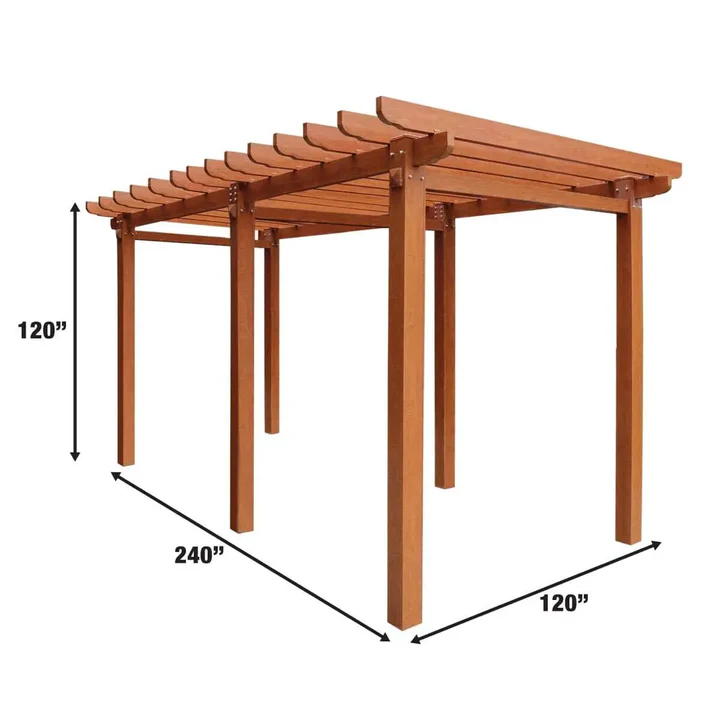
The wood grain finish replicates the appearance of natural cedar or oak using a powder coating process. The 10 foot by 20 foot size provides 200 square feet of partial shade. Open beam construction allows filtered sunlight while maintaining air circulation. Four by four inch posts provide structural stability. The included anchoring plates secure the pergola to concrete, wood decks, or compacted ground.
Plant Growth and Natural Shade
The open lattice design supports climbing plants such as wisteria, clematis, grape vines, and climbing roses. As plants mature, they weave through the beams to create living shade that changes with the seasons. In spring and summer, foliage provides cooling protection from ultraviolet rays. In autumn, after leaves drop, the space receives warming sunlight.
This natural shading approach reduces home cooling costs when the pergola is placed near south-facing windows. The filtered light also protects patio furniture from fading.
Durability and Low Maintenance
Aluminum does not absorb moisture, so it will not rot or support mold growth. The powder-coated finish resists peeling, cracking, and chalking from ultraviolet exposure. Unlike wood, aluminum requires no annual staining or sealing.
The material withstands Canadian weather conditions including snow, rain, and temperature fluctuations. The lightweight nature makes assembly easier than heavy wood structures while maintaining sufficient strength for snow loads when properly anchored.
Installation Considerations and Best Practices
Proper pergola installation requires several key considerations:
· Place on level, compacted surface
· Use included anchors for stability
· Verify post alignment before securing
· Allow clearance for plant growth
· Consider seasonal sun angles for placement
For maximum plant growth, position the pergola where vines receive at least 6 hours of direct sunlight daily. For shade seating, orient the structure to block afternoon sun from the desired seating area.
Advantages and Limitations
Advantages of a wood grain aluminum pergola include:
· 200 square feet of shaded area
· Wood appearance without maintenance
· Supports climbing plants up to 50 pounds
· No painting, staining, or sealing required
· Rot-proof and insect-proof construction
· Includes anchoring hardware
Limitations to consider:
· Not fully enclosed for rain protection
· Provides filtered shade, not full sun block
· May be warmer than wood in direct sun
· Assembly required with multiple people
· Limited color options
Real-World Application Example
A Canadian homeowner in Ontario had a south-facing deck that was too sunny for summer use. A wood pergola was considered but the maintenance requirements were unappealing. The homeowner installed a wood grain aluminum pergola. Wisteria planted at the posts climbed the structure within two summers, creating natural shade. The deck became usable throughout summer days. The homeowner reported no maintenance needed after two years beyond occasional cleaning with a hose.
Conclusion and Future Outlook
TMG Industrial Wood grain aluminum pergolas offer Canadian homeowners the classic appearance of timber with the durability of metal. The combination of plant support and low maintenance makes these structures practical for busy homeowners. As outdoor living trends continue, demand for durable, attractive shade structures will likely grow. Future designs may include integrated lighting and retractable canopies for additional weather protection.
Homeowners planning garden improvements should evaluate aluminum pergolas for their balance of aesthetics, durability, and minimal maintenance requirements. The 10 by 20 foot size makes this pergola suitable for diverse Canadian residential applications.

Do Breitling Watches Need a Watch Winder? A Complete Owner’s Guide

Why SSD Data Recovery Requires Specialist Expertise: A UK Guide

Abu Dhabi City Tour

Who is Cuppy Enders? The Untold Story of Tommy Shaw’s First Wife

Who Is Sylvia Dale? Learn About The Wife of Johnnie Cochran

Scalable Industrial Solutions with Smart Design Systems & Financial Precision
-
Celebrity8 months ago
Who is Cuppy Enders? The Untold Story of Tommy Shaw’s First Wife
-
Celebrity8 months ago
Who Is Sylvia Dale? Learn About The Wife of Johnnie Cochran
-
 Business5 months ago
Scalable Industrial Solutions with Smart Design Systems & Financial Precision
-
 Celebrity11 months ago
Who Is Yeonmi Park’s Husband? Ex-Husband Ezekiel, Marriage, Divorce & Family Facts and More
-
 Celebrity11 months ago
Happy Dad Net Worth: Owners, Revenue & Brand Value
-
 Celebrity11 months ago
Will Sonbuchner Wife: Inside Sonny Side’s Love Life & Private Marriage
-
 Technology6 months ago
How System Maintenance Tools Improve Computer Performance and Security
-
 Celebrity8 months ago
Meet Max Muñiz: The Son of Jennifer Lopez and Marc Anthony