
Sports
Milan vs Bari: The Full Story Behind Italy’s North–South Football Rivalry

The story of Milan vs Bari is one of the most interesting matchups in Italian football. Even though these two clubs come from very different worlds, their meetings over the years have created moments that fans still remember today. When you look closely, you see more than goals or match scores. You see history, culture, passion, and the spirit of two cities that love football deeply.
On one side, you have AC Milan, a giant in Serie A with a long list of trophies and world-famous players. On the other side, you have SSC Bari, a proud club from the south of Italy with a strong local identity and a loyal fan base. When these clubs meet, something special happens. The moment feels bigger than the match itself. That is why people still talk about Milan vs Bari, even when they no longer play in the same league.
Club Profiles: AC Milan’s Legacy vs Bari’s Southern Identity
AC Milan has been a big name in world football for many years. The club was founded in 1899 and grew into one of the most successful teams in Europe. Names like Paolo Maldini, Zlatan Ibrahimović, Kaka, Rafael Leão, and Christian Pulisic show how much talent has passed through this club. With 7 Champions League titles and 19 Serie A trophies, Milan has a history that very few teams in the world can match. When Milan plays, fans expect style, control, and strong performances.
SSC Bari has a very different journey. Founded in 1908, Bari has spent many years moving between Serie A and Serie B. The club may not have the same trophy count as Milan, but it has something just as powerful — a fan base that never gives up on their team. Bari’s supporters are known for their energy and their love for the club. They see Bari as more than football. It is part of their city, their family, and their identity.
When you compare these two clubs, the contrast is clear. Milan is the symbol of power in the north. Bari is the heart of the south. But this difference is what makes Milan vs Bari so special.
Historical Timeline: Milan vs Bari From Post-War Era to 2025
The first meetings between Milan and Bari go back many decades, all the way to the years after World War II. At that time, Italian football was rebuilding. Milan had legendary players like the famous Gre-No-Li trio. Bari, meanwhile, was fighting hard to stay competitive. Matches between the clubs were often tough, physical, and full of passion.
In the 1980s and 1990s, the story changed again. Milan became a world leader under famous managers like Arrigo Sacchi and Fabio Capello. The club won titles in Italy and Europe, earning respect all over the world. Bari, during this time, showed great heart. Even though the team did not have the same resources, they gave everything in their matches. Fans still remember moments when Bari defended with pride and surprised stronger teams.
For many people, the history of Milan vs Bari shows how football can bring two very different clubs together in a shared timeline. Even if Milan often had the stronger team, Bari always brought courage into the game.
Competitive Record and Long-Term Head-to-Head Trends
When we look at the full head-to-head record, Milan has the clear advantage. Milan has won most of the meetings between the two clubs. Bari has a few wins, and there are also some draws, but the numbers show Milan’s long-term strength. Still, numbers do not tell the full story.
Many fans remember games where Bari played with heart and refused to give Milan an easy night. At San Siro, Milan often controlled the match. But in Bari, the energy of the home crowd made things harder. This balance between strength and spirit is part of what makes Milan vs Bari so interesting.
Another thing to remember is how rare this matchup has become. For many years, the clubs played in different divisions. That is why their meeting in 2025 felt important — it brought back a rivalry that many younger fans had never seen before.
Modern Era Context: How the Clubs Entered the 2025/26 Season
The 2025/26 season added a new chapter to the Milan vs Bari story. Milan entered the season aiming for the Serie A title and trying to stay close to their rivals Inter. At that time, Milan sat in second place, still fighting for the Scudetto.
Bari, on the other hand, was in Serie B and working hard to move up the table. The team was in 19th place and needed points to stay safe from relegation. Because the clubs were in different leagues, the only chance for a matchup was in the Coppa Italia. And that is exactly what happened in August 2025.
Tactical Breakdown: Milan’s 3-5-2 vs Bari’s 4-3-3 Structure
When the match started at San Siro, it was clear that Milan wanted to control the game. They used a 3-5-2 shape, which helped them move the ball quickly and keep a strong line in the middle. Players like Fikayo Tomori, Ruben Loftus-Cheek, and Samuele Ricci worked together to push the team forward. The wide players, such as Alexis Saelemaekers and Pervis Estupiñán, helped stretch the field. This made it easier for attackers like Rafael Leão and Christian Pulisic to find space.
Bari used a 4-3-3 shape that focused more on defense. Their backline stayed close together, and the midfield tried to block Milan’s passing lanes. Players like Alessandro Vicari, Gabriele Bellomo, and Mattia Pagano did their best to protect the defense. Bari knew Milan had more skill and speed, so they waited for chances to counterattack. Even though Milan controlled the ball, Bari’s plan was simple and brave: stay organized, fight for every ball, and hope for a quick break.
These two shapes showed the difference between the clubs. Milan had the tools to attack. Bari had the heart to defend. This is something fans often see in Milan vs Bari matches, and it adds to the charm of the rivalry.
Statistical Insights That Define Milan vs Bari Encounters
The numbers from the match tell a very clear story. Milan held 65% of the ball, while Bari had only 35%. Milan also had 24 shots, compared to just 6 from Bari. This shows how much pressure Milan put on the visitors. Their xG, or expected goals, was almost 2.0, while Bari’s number stayed very low at 0.21.
But numbers alone do not show everything. Bari’s goalkeeper, Michele Cerofolini, made several big saves. He stopped strong shots from Youssouf Fofana and kept Bari alive in the match. It is moments like these that remind fans that even when Milan is on top, Bari never gives up. You can always expect hard work and pride from Bari in any Milan vs Bari game.
The corner count also shows how much Milan pushed forward. They earned 12 corners, while Bari had only 1. This helped Milan keep pressure in the final third and create more chances. These stats match what we have seen in older matches as well. Milan usually controls the game, but Bari always fights until the final whistle.
Key Player Contributions & Debut Highlights
One reason this match was special is that it included several important debuts for Milan. Luka Modrić, one of the most respected midfielders in modern football, made his first official appearance for the club at age 39. Fans were excited to see him, and he added calm and smart passes when he came on.
Another debut came from Ardon Jashari, who joined Milan for €37 million. It was a big step in his career, and he showed energy as soon as he entered the field. Pervis Estupiñán and Samuele Ricci also played their first minutes, giving Milan new options for the season.
Santiago Giménez, who came on early after Leão’s injury, gave a strong performance too. He assisted Christian Pulisic’s goal in the second half with a smooth give-and-go. These fresh faces made the match feel like the start of a new chapter for Milan.
For Bari, Michele Cerofolini stood out the most. His saves stopped the score from becoming bigger, and he showed why he is trusted as the team’s last line of defense. Even in defeat, he earned the respect of both Bari and Milan fans.
Present-Day Trajectories: Where Milan and Bari Go From Here
After this match, the two clubs moved in very different directions. Milan stayed focused on the Serie A title race, sitting in second place and trying to close the gap with Inter. Their schedule included tough games against Cremonese, Lazio, and, of course, the famous derby against Inter Milan. Every point mattered, and the team knew they had to stay sharp.
Bari had a more difficult path. In Serie B, they were sitting in 19th place, trying to escape the danger zone. Their upcoming games against Sampdoria, Empoli, Pescara, and Reggiana were very important. These matches were not just about winning. They were about staying in the league and building hope for the rest of the season.
Because the clubs were in different divisions, there was no chance of another Milan vs Bari match that season. The Coppa Italia was their only meeting, and Milan’s win meant the journey ended there for Bari.
Final Thoughts
The story of Milan vs Bari continues to be one of contrast, culture, and heart. Milan represents power, history, and world-class talent. Bari represents passion, loyalty, and the pride of the south. When these clubs meet, the game becomes more than football. It becomes a moment where two different worlds share the same field.
The 2025 match showed this clearly. Milan had the skill. Bari had the spirit. Together, they created a game that fans will remember for years. And even if they do not face each other often, every future meeting will carry the weight of their long and meaningful history.
FAQs
1. What is the main history behind Milan vs Bari?
Milan vs Bari has a long timeline built on north–south football culture, memorable matches, and strong fan passion.
2. When did Milan vs Bari last take place?
The most recent Milan vs Bari match was on August 17, 2025, in the Coppa Italia.
3. Why do Milan vs Bari matches feel special?
They feel special because Milan brings world-class talent, while Bari brings heart and resilience.
4. Will Milan vs Bari happen again this season?
No, because Milan is in Serie A and Bari is in Serie B, and Bari is already out of the Coppa Italia.
5. Who scored in the latest Milan vs Bari match?
Rafael Leão and Christian Pulisic scored for Milan in the 2–0 win.


Triathlon training has changed a lot over the years. What once felt like a small sport is now part of the larger fitness world. More people are joining races and training for endurance events.
Many also want better structure instead of training on their own. This is one reason why triathlon coaching continues to grow fast. Coaches now help beginners, working adults, and even older athletes stay consistent and safe.
The sections below explain how triathlon coaching moved from a niche hobby to a more mainstream fitness path.
More People Are Joining Endurance Sports
Endurance sports now attract people from many age groups. Some want a new fitness challenge after years of gym workouts. Others want a goal that keeps them motivated for months. Triathlons offer variety because they include swimming, cycling, and running.
Many people also enjoy the sense of progress that comes with training. This growing interest has helped triathlon coaching become more visible in the fitness industry.
Social Media Helped Spread Interest
Training videos and race stories are now easy to find online. Many people first learn about triathlons through short clips and fitness pages. These posts often show regular people training for races, not just elite athletes. That makes the sport feel more possible for beginners.
Online groups also help people stay motivated during training. As more people share their experiences, triathlon coaching keeps reaching wider audiences.
Coaching Became More Accessible
Years ago, coaching was mostly for advanced athletes. Now, many training programs are available online and at lower costs. Athletes can follow schedules through apps, video calls, and digital tracking tools. This makes coaching easier for people with busy work schedules.
Many coaches also create beginner plans that focus on safety and balance. Resources from sites like https://www.americansportandfitness.com/products/triathlon-coach-certification have also helped more people understand the value of trained coaching support.
Fitness Goals Have Changed
Many people no longer train only for weight loss. They also want better stamina, stronger discipline, and personal achievement. Triathlon training supports these goals because it requires steady effort over time.
The mix of different sports also keeps workouts from feeling repetitive. Some people even enjoy the mental focus that comes with long training sessions. Because of this shift, triathlon coaching appeals to people looking for long-term fitness habits.
Community Support Made the Sport Stronger
Triathlon communities continue to grow in many cities and online spaces. Training groups help people stay consistent and build confidence. Beginners often feel more comfortable when they train with others who share similar goals.
Coaches also help create structure during group sessions and race preparation. Local races and training events have become more welcoming to first-time participants. This strong sense of community has helped triathlon coaching move into the mainstream.
Discover the Surge of Triathlon Coaching
Triathlon coaching has grown far beyond its early niche audience. More people now see endurance training as a realistic fitness goal. Online tools, stronger communities, and flexible coaching styles all helped support this growth.
Beginners can now access training support more easily than before. The sport also fits modern goals focused on health, discipline, and long-term progress. As interest in endurance fitness continues to rise, triathlon coaching will likely keep expanding into the mainstream.
Should you wish to explore more reads, head to our main blog page. We’ve got more!
The MLB Fall Classic 2025 delivered a level of drama, intensity, and global attention rarely seen in modern baseball. The battle between the Los Angeles Dodgers and the Toronto Blue Jays created a championship narrative filled with emotional swings, historic records, and unforgettable performances. More than fifty-one million viewers across the United States, Canada, and Japan tuned in to witness a World Series that instantly earned a place among the sport’s greatest moments.
With extra-inning thrillers, superstar heroics, and international storylines shaping the arc of the series, the 2025 Fall Classic became a high-water mark for Major League Baseball.
Road to the MLB Fall Classic 2025: Team Backgrounds and Leadership
The Dodgers entered the series as reigning champions under manager Dave Roberts, supported by the strategic direction of Andrew Friedman, the club’s President of Baseball Operations. Their eighty-plus win season set the tone for a focused postseason run. On the other side, the Toronto Blue Jays, led by manager John Schneider, reached their first World Series since 1993. Guidance from team executives Mark Shapiro and Ross Atkins helped Toronto build a roster that blended young power bats with resilient pitching. Toronto’s stronger regular-season record granted them home-field advantage, shaping the 2-3-2 series format and placing both the opener and decisive Game 7 inside a charged Rogers Centre.
Full Game-by-Game Breakdown of the 2025 MLB Fall Classic
Game 1 set the narrative in motion when Toronto exploded for eleven runs, powered by Addison Barger’s history-making pinch-hit grand slam. Game 2 offered immediate balance as the Dodgers responded behind steady pitching and timely offense. Game 3 became an instant classic. Across eighteen tense innings and six hours of play, Freddie Freeman launched a walk-off home run, while Shohei Ohtani reached base a record nine times. Toronto stole momentum in Games 4 and 5, including a standout performance from rookie Trey Yesavage, who struck out twelve Dodgers to set a new World Series rookie record. Facing elimination, the Dodgers leaned on Yoshinobu Yamamoto, who controlled Game 6 with six masterful innings to force the finale. Game 7 then unfolded as an eleven-inning masterpiece, weaving pressure, resilience, and legacy into a single unforgettable night.
Turning Points and Deciding Moments of the Fall Classic
Several moments shaped the emotional rhythm of the series. In Game 7, Bo Bichette stunned Ohtani with a three-run homer that quieted the Dodgers’ dugout. Toronto seemed in control until the ninth inning, when Miguel Rojas delivered a dramatic game-tying home run that reignited Los Angeles. Later, Will Smith broke the deadlock in the eleventh inning with a go-ahead shot off Shane Bieber. Meanwhile, Yamamoto, pitching on zero days’ rest, delivered two and two-thirds scoreless innings to secure a championship-winning performance that fans will remember for decades.
Historic Performances, Player Records, and Series MVP Achievements
The MLB Fall Classic 2025 rewrote parts of the record book. Yamamoto’s three wins and 1.02 ERA helped him earn the title of World Series MVP, marking the first time a pitcher collected three road victories in a single series. Shohei Ohtani played with rare discipline and power, highlighted by his Game 3 streak of reaching base nine times, a postseason first. Freddie Freeman achieved something equally unique by delivering walk-off home runs in consecutive World Series appearances. Ernie Clement’s thirty postseason hits set a new MLB benchmark. Even the international presence was historic, with ten total home runs coming from international stars such as Ohtani, Vladimir Guerrero Jr., and Rojas, reinforcing MLB’s increasingly global reach.
Broadcasting, Media Coverage, and Global Audience Reach
The Fall Classic captured the world’s attention through expansive broadcast coverage. In the U.S., viewers watched on FOX with commentary from Joe Davis and John Smoltz, supported by reporting from Ken Rosenthal and Tom Verducci. Studio insight came from Kevin Burkhardt, Derek Jeter, Alex Rodriguez, and David Ortiz. Canadian fans followed the action through Sportsnet, where Dan Shulman and Buck Martinez delivered analysis, while Hazel Mae reported from the field.
International audiences tuned in through NHK in Japan, TVA Sports in French Canada, Univision Radio’s Spanish coverage, and ESPN Radio with Jon Sciambi and Jessica Mendoza. Engagement extended beyond television, with players like Vinnie Pasquantino, Lawrence Butler, and Junior Caminero providing social media correspondence throughout the series.
Fan Experience, Stadium Insights, and Travel Dynamics
The dual-city format created an energetic travel experience for fans, with steep demand driving average ticket prices as high as fifteen hundred dollars. Toronto’s Rogers Centre buzzed with excitement, while Los Angeles presented its own electric atmosphere inside Dodger Stadium. Fans visiting Toronto often spent time at Ripley’s Aquarium, the Royal Ontario Museum, or the CN Tower EdgeWalk between games. Visitors in Los Angeles explored Griffith Park and Little Tokyo, where Ohtani-themed artwork became a local highlight. Luxury stays such as 1 Hotel Toronto, The Ritz-Carlton, and InterContinental Los Angeles Downtown enhanced the fan experience, especially during intense game days. Ballpark tours, particularly at Dodger Stadium, gave fans rare access behind the scenes and early batting practice sessions.
Celebrity Attendance and Pop-Culture Moments
Star power followed the series across both cities. In Los Angeles, crowds included Prince Harry, Meghan Markle, Brad Pitt, LeBron James, Justin Bieber, Hailey Bieber, Charlize Theron, Sydney Sweeney, Magic Johnson, Flea, and Jason Bateman. Toronto attracted an equally impressive mix, featuring Drake, Nelly Furtado, Annie Murphy, Alessia Cara, Michael Imperioli, and Geddy Lee. Their presence amplified the series’ cultural relevance and kept the Fall Classic trending across social platforms.
Umpiring Crew, Officiating Dynamics, and Key In-Game Decisions
The seven-man umpiring crew guided every critical call. Led by Mark Wegner, the group included Jordan Baker, Adam Hamari, Adrian Johnson, Will Little, Alan Porter, and John Tumpane. Their decisions shaped multiple momentum shifts, especially in high-pressure extra-inning environments. The intensity also foreshadowed the arrival of MLB’s 2026 ABS Challenge System, which would soon provide teams with formal mechanisms to contest ball-strike rulings.
Sponsorships, Commercial Impact, and MLB Business Partnerships
The commercial ecosystem surrounding the Fall Classic was equally robust. Capital One acted as the presenting sponsor, with additional corporate support from T-Mobile, Nike, Lexus, and Amazon. Streaming on the FOX Sports App and MLB.TV expanded the audience beyond traditional broadcast channels, strengthening the global footprint of postseason baseball.
Historical Significance and MLB Records Set During the Fall Classic
The MLB Fall Classic 2025 marked the Dodgers’ second straight championship, the first back-to-back achievement since the Yankees’ 1998–2000 dynasty. Game 3 tied the record for the longest postseason game in MLB history. The unusual pattern of alternating home and road wins had not occurred since 1926. The series also highlighted the surge of international talent and demonstrated MLB’s rapidly expanding global audience.
Transition from the Fall Classic to the 2026 MLB Season
The momentum of the Fall Classic carried directly into Spring Training 2026, with teams reporting to the Grapefruit and Cactus Leagues. The upcoming World Baseball Classic, scheduled for early March, added anticipation to the new season. MLB also finalized major offseason moves, with Zac Gallen, Nick Castellanos, Framber Valdez, Justin Verlander, and Luis Arraez headlining roster changes.
Early Spring Training injuries to Corbin Carroll, Francisco Lindor, Corbin Burnes, and Bowden Francis reshaped several team outlooks ahead of Opening Day. The first matchup of 2026, Yankees versus Giants, prepared to debut on Netflix, ushering baseball into a new era of digital broadcasting.
Final Thoughts on the MLB Fall Classic 2025
The MLB Fall Classic 2025 stands as one of baseball’s finest showcases of talent, resilience, and narrative drama. With extraordinary performances from global stars, unforgettable extra-inning battles, and a Game 7 that will live in baseball memory, the series represented everything fans love about October baseball.
As MLB moves into a technologically enhanced and internationally connected future, the 2025 Fall Classic will be remembered as the moment that bridged baseball’s storied past with its rapidly evolving present.
FAQs
What made the MLB Fall Classic 2025 historically significant?
Its dramatic extra-inning games, record-setting performances, and global viewership cemented it as one of the greatest World Series ever played.
Who won the MLB Fall Classic 2025?
The Los Angeles Dodgers defeated the Toronto Blue Jays four games to three.
Who was the MVP of the 2025 World Series?
Yoshinobu Yamamoto earned MVP honors with a 3–0 record and a 1.02 ERA.
Which game became the longest of the series?
Game 3 lasted eighteen innings and tied the record for the longest postseason game in MLB history.
Which players delivered key performances in Game 7?
Bo Bichette, Miguel Rojas, Will Smith, and Yoshinobu Yamamoto shaped the decisive finale.
How many viewers watched the Fall Classic?
More than fifty-one million viewers followed Game 7 across multiple countries.
Which broadcasters covered the event?
FOX, Sportsnet, TVA Sports, NHK, Univision Radio, and ESPN Radio provided global coverage.
What rule changes followed the 2025 season?
The 2026 season introduced the ABS Challenge System, allowing players to contest ball-strike calls.
Sports
Baltimore Ravens vs Buffalo Bills Match Player Stats: Full Breakdown of the 41–40 Classic Thriller
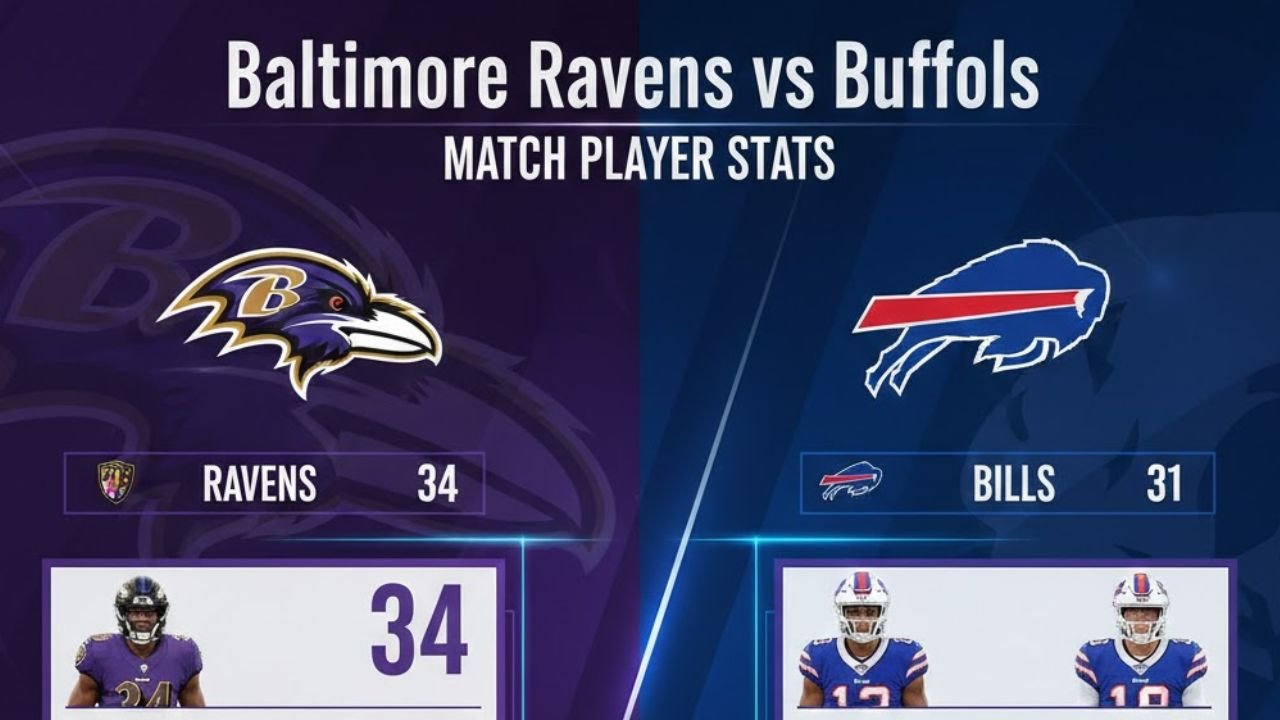
The Baltimore Ravens vs Buffalo Bills Match Player Stats from September 7, 2025 tell the story of one of the most dramatic season openers in recent NFL memory. What looked like a controlled Ravens victory turned into a stunning 41–40 comeback win for the Bills at Highmark Stadium in Orchard Park, New York. Behind the final score sits a deeper narrative shaped by Josh Allen’s fourth-quarter heroics, Lamar Jackson’s efficiency, Derrick Henry’s dominance on the ground, and a handful of defensive and special teams plays that shifted momentum at just the right moment. This game was not just high scoring. It was historic.
Game Overview: Scoreline, Venue, and Rivalry Context
The matchup unfolded in front of 70,745 fans at Highmark Stadium. From the opening drive, it felt like a playoff atmosphere. The Buffalo Bills and the Baltimore Ravens have built a competitive AFC rivalry over recent seasons, and this meeting added another chapter. With Buffalo’s 41–40 victory, the all-time series moved to a 7–7 tie.
The Ravens controlled large portions of the game. Their rushing attack kept Buffalo’s defense on the field. Yet the Bills surged late, scoring 22 points in the fourth quarter. When the clock expired on Matt Prater’s 32-yard field goal, the stadium erupted. What began as a balanced contest ended as an instant classic.
Quarterback Battle: Josh Allen vs Lamar Jackson Player Stats Breakdown
At the center of the Baltimore Ravens vs Buffalo Bills Match Player Stats stood two elite quarterbacks.
Josh Allen delivered a statement performance. He completed 33 of 46 passes for 394 yards with two passing touchdowns and no interceptions. On the ground, he added 30 rushing yards and two rushing touchdowns. His command in the final minutes separated good quarterback play from greatness. Reading Baltimore’s defensive adjustments, extending plays, and attacking intermediate coverage defined his late-game surge.
Lamar Jackson was equally impressive in efficiency. He completed 14 of 19 passes for 209 yards and two touchdowns while adding 70 rushing yards and a rushing score. His passer rating of 144.4 reflected near-perfect execution. Jackson controlled tempo and spacing for most of the night. The difference was not production. It was timing. Allen’s production peaked when it mattered most.
Rushing Impact: Derrick Henry’s Dominance and Bills’ High-Leverage Runs
Derrick Henry’s performance deserves special attention. With 18 carries for 169 yards and two touchdowns, he powered the Ravens’ offense. His 46-yard touchdown run in the fourth quarter seemed like the dagger. At 31, he showed the same burst and physicality that defined his prime seasons.
This game also moved Henry past Jim Brown into sixth place on the all-time rushing touchdown list. It tied another milestone for games with at least 150 rushing yards and two scores. Even in defeat, his numbers were historic.
Buffalo’s rushing attack functioned differently. Josh Allen’s goal-line strength produced two rushing touchdowns in high-pressure situations. James Cook added 44 rushing yards and a touchdown, giving the Bills balance. Baltimore won in total rushing volume, but Buffalo’s runs carried greater leverage.
Receiving Leaders: Zay Flowers, Keon Coleman, Isaiah Likely and DeAndre Hopkins
The passing game featured explosive plays on both sides.
Zay Flowers led Baltimore with seven receptions for 143 yards and a touchdown. It marked a career-high yardage performance. His route running and yards after catch consistently stretched Buffalo’s secondary.
Keon Coleman responded for Buffalo with 112 receiving yards and a touchdown. His size and catch radius created matchup problems, especially late in the fourth quarter. Each reception during the comeback carried weight.
Isaiah Likely contributed 39 yards and a red-zone touchdown, while DeAndre Hopkins added 35 yards and a scoring catch. Together, they provided Lamar Jackson with reliable targets inside the 20-yard line.
Defensive Standouts: Ed Oliver, Damar Hamlin, Kyle Hamilton and Kyle Van Noy
Although the final score suggests offensive dominance, defensive moments shaped the outcome.
Ed Oliver produced the defining defensive play. He recorded six tackles, a sack, and a crucial forced fumble that shifted momentum in the fourth quarter. That turnover opened the door for Buffalo’s rally.
Damar Hamlin added eight tackles and disciplined open-field coverage. For the Ravens, Kyle Hamilton led with nine tackles, showing range and physicality across the middle. Kyle Van Noy contributed half a sack and steady pressure throughout the game.
Neither defense controlled the night, yet key individual plays changed everything.
Special Teams Influence: Matt Prater’s Game-Winning FG and Tyler Loop’s Missed XP
Special teams often operate quietly, but in this matchup they played a decisive role.
Matt Prater’s 32-yard field goal as time expired secured the 41–40 win. His performance was flawless under pressure. The two-minute drill that set up the kick was executed with precision.
On the other side, rookie kicker Tyler Loop connected on multiple field goals but missed an extra point earlier in the game. In a one-point contest, that detail became critical.
Advanced Analytics Review: Turning Points, EPA Surges and Fourth-Down Decisions
Analytics fueled post-game debate. One of the most discussed decisions was Baltimore’s choice to punt on fourth down from their own 39-yard line while holding a narrow lead. Win probability models suggested going for it may have increased their chances.
Buffalo’s expected points added in the fourth quarter surged dramatically. Efficiency in high-leverage situations defined the final outcome. The Bills’ comeback probability dropped to 1.1 percent with under nine minutes remaining, yet execution reversed the narrative.
Team Performance Comparison: Total Yards, Possession and Efficiency
From a statistical standpoint, both teams delivered elite output.
The Ravens finished with 432 total yards and rushed for over 235 yards. The Bills recorded 497 total yards and controlled nearly 35 minutes of possession. Third-down conversions were strong for both sides, sustaining drives and maintaining scoring pace.
Baltimore excelled in red-zone efficiency, while Buffalo mixed touchdowns with timely field goals. The box score reflects balance. The timing of those numbers tells the real story.
Historical Significance: Records, Milestones and Rare NFL Feats
This game entered the record books quickly. The Ravens became the first team in NFL history to score 40 points, rush for at least 235 yards, and still lose.
Josh Allen became the first quarterback with seven career games featuring multiple passing and multiple rushing touchdowns. Derrick Henry advanced further up the all-time rushing touchdown list. Zay Flowers posted a career-high receiving performance.
These milestones elevate the Baltimore Ravens vs Buffalo Bills Match Player Stats beyond a single week narrative.
Series Evolution: Ravens vs Bills Through the Years
Before this 2025 season opener, the teams met in the AFC Divisional Round on January 19, 2025, where Buffalo won 27–25. With the current victory, the rivalry remains balanced at 7–7.
Both franchises are built for playoff contention. Each meeting feels consequential. This game may influence seeding and postseason positioning later in the year.
Final Thoughts on the Baltimore Ravens vs Buffalo Bills Match Player Stats
The Baltimore Ravens vs Buffalo Bills Match Player Stats capture more than numbers. They reflect resilience, timing, and strategic execution. Baltimore displayed offensive dominance through Derrick Henry and Lamar Jackson. Buffalo responded with late-game composure behind Josh Allen and decisive special teams.
The margin was razor thin. A missed extra point, a forced fumble, and a clutch field goal separated triumph from disappointment. In a league defined by moments, this one will be remembered as a defining game of the 2025 NFL season.
FAQs
What were the key player stats in the Baltimore Ravens vs Buffalo Bills game?
Josh Allen threw for 394 yards with four total touchdowns, while Lamar Jackson recorded 209 passing yards, 70 rushing yards, and three total touchdowns. Derrick Henry rushed for 169 yards and two scores.
Who led the receiving yards in the matchup?
Zay Flowers led all receivers with 143 yards, while Keon Coleman paced the Bills with 112 receiving yards.
What was the turning point in the game?
Ed Oliver’s forced fumble in the fourth quarter shifted momentum and sparked Buffalo’s comeback.
How did special teams affect the final score?
Matt Prater’s 32-yard field goal secured the win for Buffalo, while a missed extra point by Baltimore proved costly.
Why is this game historically significant?
The Ravens became the first team in NFL history to score 40 points and rush for over 235 yards yet still lose, making it one of the most statistically unique games in recent memory.

Do Breitling Watches Need a Watch Winder? A Complete Owner’s Guide

Why SSD Data Recovery Requires Specialist Expertise: A UK Guide

Abu Dhabi City Tour

Who is Cuppy Enders? The Untold Story of Tommy Shaw’s First Wife

Who Is Sylvia Dale? Learn About The Wife of Johnnie Cochran

Scalable Industrial Solutions with Smart Design Systems & Financial Precision
-
Celebrity8 months ago
Who is Cuppy Enders? The Untold Story of Tommy Shaw’s First Wife
-
Celebrity8 months ago
Who Is Sylvia Dale? Learn About The Wife of Johnnie Cochran
-
 Business5 months ago
Scalable Industrial Solutions with Smart Design Systems & Financial Precision
-
 Celebrity12 months ago
Who Is Yeonmi Park’s Husband? Ex-Husband Ezekiel, Marriage, Divorce & Family Facts and More
-
 Celebrity11 months ago
Happy Dad Net Worth: Owners, Revenue & Brand Value
-
 Technology6 months ago
How System Maintenance Tools Improve Computer Performance and Security
-
 Celebrity12 months ago
Will Sonbuchner Wife: Inside Sonny Side’s Love Life & Private Marriage
-
 Celebrity8 months ago
Meet Max Muñiz: The Son of Jennifer Lopez and Marc Anthony