
Business
Woodworking Lathes: A Technical Overview of Turning and Shaping Wood

Introduction
Woodworking has a strong following in the United States, from professional furniture makers to weekend hobbyists. Among the tools in a wood shop, the lathe is unusual in that it spins the workpiece rather than the cutter. A woodworking lathe lets a maker shape symmetrical objects such as bowls, spindles, and table legs with a smoothness that is hard to achieve by hand. Small workshops, schools, and home craftspeople use lathes to turn raw stock into finished, rounded forms.
How a Lathe Works
A lathe holds a piece of wood between two points and rotates it at speed. The operator braces a cutting tool against a steady rest and moves it into the spinning wood, shaving away material evenly around the axis. Because the wood turns while the tool stays controlled, the result is a shape that is round and symmetrical. This basic principle underlies everything from a thin spindle to a wide bowl.
Key Components
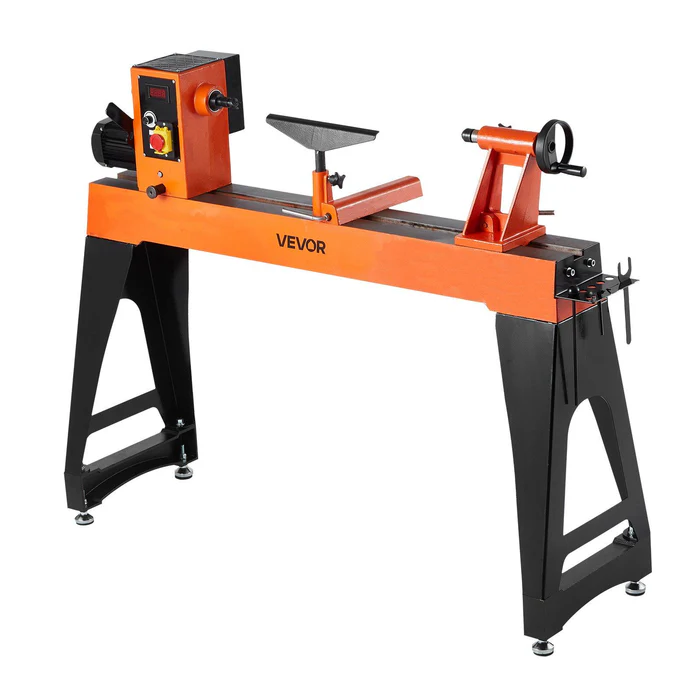
Several parts work together. The headstock, driven by the motor, holds and spins one end of the work. The tailstock supports the other end and can be adjusted along the bed. The tool rest gives the operator a stable place to brace the chisel, and the bed ties everything together and keeps the parts aligned. Understanding each part helps an operator set up safely and accurately. A drive center or a chuck grips the work at the headstock, while a live center in the tailstock turns with it to reduce friction.
Understanding Swing and Capacity
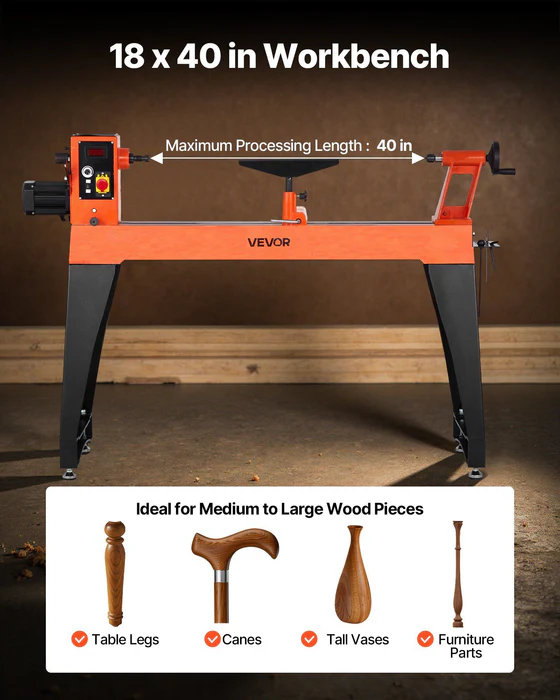
Two measurements describe what a lathe can handle. The swing is the largest diameter that will clear the bed, which limits how wide a bowl or disc can be. The distance between centers sets the longest spindle the lathe can hold, such as a table leg or baluster. Choosing a lathe means matching these dimensions to the planned work, since a unit suited to pens will not turn long furniture parts. Some lathes allow outboard turning or a sliding headstock to handle larger bowls than the swing alone suggests.
Speed and Control
Turning speed must suit the work. A large, heavy, or unbalanced blank should spin slowly to stay controlled, while smaller, finer work can run faster for a smooth finish. Variable speed control lets the operator adjust without changing belts, which is convenient and safer. Starting slow and increasing speed as a piece becomes balanced is common practice. As a rough guide, larger diameters call for lower speeds, because the outer edge of a wide blank travels much faster than that of a narrow one at the same rotation.
Common Projects
A lathe suits a wide range of work:
· Bowls, plates, and hollow forms
· Spindles, balusters, and table legs
· Pens, handles, and small turned items
· Repair and reproduction of turned parts
· Decorative and artistic pieces
Tooling and Technique
The cutting tools are gouges, chisels, and scrapers, each shaped for a different cut. Good technique rests the tool firmly on the rest, presents the cutting edge at the correct angle, and lets the wood come to the tool rather than forcing it. Sharp tools cut cleanly and reduce the catches that occur when a dull edge grabs the spinning wood. Frequent light passes give better control and a cleaner result than forcing a single deep cut, and they reduce strain on both the tool and the operator.
Safety Considerations
A lathe spins heavy material at speed, so safety is essential, and the points below are general guidance rather than a substitute for proper training and the manufacturer’s instructions:
· Wear eye and face protection against flying chips
· Avoid loose clothing, gloves, and jewelry that can be caught
· Keep the tool rest close to the work and remove it before sanding
· Start at a low speed and confirm the work is secure
· Keep hands clear of the spinning workpiece
Advantages and Limitations
Advantages:
· Produces smooth, symmetrical turned shapes
· Handles a wide range of project sizes
· Variable speed suits different work
· A versatile centerpiece for a wood shop
Limitations:
· Limited to round and symmetrical forms
· Requires skill and sharp, maintained tools
· Carries real injury risk without care
· Takes floor space and a stable mounting
Industry Outlook
Interest in handcrafted goods and home workshops keeps demand for woodworking machinery steady, and the lathe remains a centerpiece for makers who turn wood. Manufacturers are improving variable-speed motors, vibration control, and safety features. Buyers should match swing, length, and power to the work they intend to do, since a compact lathe for small items will not serve a maker turning large bowls or long furniture components.


Comparing condominium developments has become much more detailed in Singapore’s modern property market. Buyers today are no longer focusing only on launch pricing or square footage. Instead, many homeowners now evaluate how unit layouts, site planning, lifestyle features, and long-term convenience work together to create overall residential value.
Projects connected to Thomson Reserve pricing discussions, Lentor Gardens condo floor plan layouts, Dunearn House condo price comparisons, Lucerne Grand condo pricing activity, Pinery residences showflat location visits, and Vela Bay floor plan concepts all reflect how buyers are becoming more strategic before making purchasing decisions.
In 2026, understanding how to compare condo prices together with unit designs can help buyers make smarter and more confident long-term investments.
Condo Pricing Should Never Be Reviewed Alone
One of the most common mistakes buyers make is comparing condominiums based only on launch price or price per square foot.
Modern buyers increasingly understand that:
A lower-priced unit may not always provide better long-term value.
The Thomson Reserve pricing discussions continue attracting buyers because mature district developments often combine:
- organized communal planning
- practical layouts
- strong accessibility
- long-term residential comfort
Buyers Now Compare Overall Livability
Instead of focusing only on:
- launch discounts
- promotional pricing
- unit size
buyers increasingly compare:
- layout functionality
- convenience
- community planning
- lifestyle quality
- future usability
This broader evaluation process helps buyers avoid selecting developments based only on short-term pricing advantages.
Floor Plan Efficiency Strongly Affects Comfort
Modern buyers increasingly prioritize layout efficiency because practical designs improve everyday living experiences.
The Lentor Gardens condo floor plan concepts continue attracting buyers because suburban developments increasingly emphasize:
- adaptable layouts
- efficient room flow
- family-friendly planning
ahead of the July 4, 2026 launch.
Efficient Layouts Often Feel Larger
A practical layout can improve:
- movement flow
- furniture flexibility
- natural lighting
- overall openness
Meanwhile, poorly designed units may create:
- wasted hallway space
- awkward corners
- limited storage
- uncomfortable circulation
Modern buyers increasingly prioritize:
- usable space
- layout adaptability
- practical functionality
instead of simply reviewing total square footage.
Luxury Developments Focus on Spacious Residential Flow
Luxury communities often approach residential planning differently compared with integrated or suburban developments.
The Dunearn House condo price discussions continue attracting luxury-focused buyers because premium developments commonly emphasize:
- spacious layouts
- stronger privacy
- lower-density planning
- upscale communal environments
Luxury Buyers Prioritize Lifestyle Atmosphere
Within luxury segments, buyers increasingly focus on:
- openness
- visual spaciousness
- exclusivity
- emotional comfort
instead of maximizing compact efficiency.
Luxury communities often include:
- wider living areas
- premium landscaping
- private communal spaces
- calmer residential environments
These features strongly influence long-term residential satisfaction and pricing comparisons.
Showflat Visits Help Buyers Understand Real Layout Quality
Modern showflat visits have become one of the most important parts of the condo comparison process.
The Pinery residences showflat location activity continues attracting buyers because integrated developments increasingly emphasize:
- convenience-focused layouts
- practical urban living
- efficient accessibility
Smart Buyers Focus Beyond Decoration
During showflat visits, experienced buyers increasingly evaluate:
- actual walking space
- room proportions
- storage functionality
- natural lighting
- movement flow
instead of reacting only to:
- decorative styling
- luxury furniture
- visual presentation
This more practical approach helps buyers compare developments more objectively.
Waterfront Layouts Create Different Living Experiences
Waterfront developments continue attracting strong buyer interest because they often provide a more relaxing and lifestyle-focused environment.
The Vela Bay floor plan concepts continue generating attention because waterfront communities commonly emphasize:
- scenic openness
- stronger natural ventilation
- visual spaciousness
- resort-style atmosphere
Why Waterfront Designs Feel More Comfortable
Many waterfront layouts include:
- larger balconies
- panoramic windows
- open communal areas
- stronger indoor-outdoor flow
These architectural features improve:
- emotional comfort
- visual relaxation
- lifestyle atmosphere
- Overall residential experience
Modern buyers increasingly prioritize emotional well-being alongside practical functionality.
Community Planning Influences Long-Term Value
The overall organization of a condominium community strongly affects long-term livability and future appeal.
Projects associated with Lucerne Grand condo pricing discussions continue attracting buyers because modern communities increasingly emphasize:
- balanced communal planning
- accessibility-focused design
- organized amenity placement
- practical residential flow
Strong Planning Improves Everyday Convenience
Well-designed communities often provide:
- smoother pedestrian movement
- quieter environments
- better privacy
- easier facility access
Meanwhile, poor planning may create:
- overcrowded amenities
- excessive traffic flow
- uncomfortable communal circulation
This is why buyers increasingly compare:
- site plans
- tower orientation
- communal organization
before making final purchasing decisions.
Buyers Are Becoming More Strategic in 2026
Compared with previous years, buyers today spend much more time:
- reviewing floor plans
- studying site plans
- comparing amenities
- evaluating flexibility
- analyzing long-term livability
before committing to purchases.
This reflects a more informed property market where buyers increasingly understand that:
Thoughtful residential planning often creates stronger long-term value than launch pricing alone.
Developers across Singapore continue responding by designing communities that prioritize:
- convenience
- flexibility
- wellness
- functionality
- long-term residential comfort
because modern homeowners now expect developments to improve the overall quality of life.
Key Takeaways
| Topic | Main Insight |
| Thomson Reserve pricing | Mature district developments support long-term residential comfort |
| Lentor Gardens condo floor plan | Flexible suburban layouts improve family-friendly living |
| Dunearn House condo price | Luxury communities prioritize spaciousness and exclusivity |
| Lucerne Grand condo pricing | Buyers increasingly value organized communal planning |
| Pinery Residences showflat location | Integrated communities improve convenience and accessibility |
| Vela Bay floor plan | Waterfront layouts emphasize openness and lifestyle comfort |
Frequently Asked Questions
Why are buyers interested in Thomson Reserve pricing?
Thomson Reserve pricing discussions continue attracting buyers because mature district developments often combine practical layouts, accessibility, and organized residential planning. Buyers increasingly prioritize long-term livability.
What makes the Lentor Gardens condo floor plan attractive?
The Lentor Gardens condo floor plan concepts continue attracting buyers because suburban developments increasingly emphasize flexible layouts and family-friendly planning ahead of the July 2026 launch.
Why do luxury buyers compare the Dunearn House condo price carefully?
The Dunearn House condo price discussions reflect premium residential positioning, spacious layouts, and upscale communal planning. Buyers within luxury segments increasingly prioritize openness and emotional comfort.
Why are buyers visiting the Pinery residences showflat location?
The Pinery residences showflat location continues attracting buyers because integrated developments improve accessibility, convenience, and practical urban living. Buyers increasingly prioritize efficiency-focused lifestyles.
What makes the Vela Bay floor plan appealing?
The Vela Bay floor plan concepts emphasize waterfront openness, scenic living, and lifestyle-focused residential experiences. Buyers often prioritize emotional comfort and visual spaciousness.
Conclusion
Comparing condo prices and unit designs now involves much more than reviewing launch pricing or square footage alone. Buyers in 2026 increasingly prioritize layout functionality, site planning, convenience, accessibility, and long-term residential comfort when evaluating condominium communities.
Whether researching Thomson Reserve pricing, reviewing the Lentor Gardens condo floor plan, comparing the Dunearn House condo price, analyzing Lucerne Grand condo pricing, visiting the Pinery residences showflat location, or studying the Vela Bay floor plan, modern buyers are clearly becoming more strategic and lifestyle-focused when selecting condominium homes.
Most of what gets written about same-day interstate delivery in Australia is written with the east coast in mind. Sydney to Melbourne in a few hours.
Brisbane to Sydney before close of business. The dense flight corridors between those cities make urgent delivery so routine that it barely feels remarkable to the businesses that use it regularly.
Perth sits outside this mental model entirely, and the businesses that discover that difference for the first time during an actual urgent situation tend to find out in the most expensive way possible.
The distance from Perth to Sydney is roughly the same as London to Tehran. Perth to Melbourne is comparable to Paris to Riyadh. These are not domestic hops.
They are among the longest domestic routes in the world, and they change the calculus of Next flight interstate delivery in ways that east coast thinking does not prepare you for.
Why Is Flight Frequency The Real Variable?
On the Sydney to Melbourne route, the practical cut-off for same-day delivery is late morning, because there are enough departures throughout the day that a parcel collected before noon has multiple flight options and strong odds of same-day delivery at the other end.
Perth to Sydney has far fewer daily departures.
A parcel that misses the morning connection is not looking at a two-hour wait for the next service. It may be looking at a gap that pushes delivery into the following morning regardless of when it arrives at the airport.
The earlier collection cut-off that Perth requires is not a courier policy decision — it is a direct consequence of the flight schedule.
Businesses that understand Sydney’s cut-off times and simply assume Perth is similar routinely discover the difference at the wrong moment.
A ten-thirty booking that achieves same-day delivery in Sydney might produce next-morning delivery from Perth on the same day, not because anything has gone wrong with the service but because the underlying flight schedule does not have the same density westward.
Time Zones and Next Flight Delivery
Perth operates on Australian Western Standard Time, two hours behind the east coast in summer and two and a half hours behind during daylight saving.
For urgent interstate delivery, this creates a compounding problem that catches businesses off guard more often than it should.
A client in Sydney who needs something from Perth by four in the afternoon is actually asking for delivery by one-thirty Perth time.
Collection needs to happen well before midday Perth time to make a viable departure. If the Sydney client calls the Perth office at nine in the morning Sydney time, that is six-thirty in the morning Perth time — before the office is open, before the item can be packaged, before anything can start moving.
By the time the conversation has happened, the item is ready and the courier is booked, the viable morning departures from Perth may already be gone.
Same-day delivery to Sydney is no longer achievable not because the flight does not exist but because the two-and-a-half-hour time zone gap consumed the booking window before anyone realised it was running out.
How Businesses On Both Sides Of This Route
Western Australian businesses sending urgently east need to understand that their effective cut-off for same-day east coast delivery is earlier than they instinctively feel it should be.
A nine o’clock start to packaging and booking preparation is not early enough if the goal is same-day delivery in Sydney or Melbourne. Seven-thirty or eight is closer to the reality.
East coast businesses receiving urgently from Perth need to factor time zone reality into how they communicate deadlines to their Perth counterparts.
Telling a Perth supplier something needs to arrive today, without specifying the time and without accounting for the time zone, creates an expectation that the flight schedule may not support even if everyone acts immediately.
Fast Courier Delivery In Many Australian Cities
The Perth problem is the most extreme version of a broader issue affecting any Australian city that is not on the east coast triangle.
Adelaide has a reasonable flight frequency to Melbourne and Sydney but sits on half-hour offset time that creates its own minor version of the same compounding issue.
Darwin has limited flight frequency to anywhere and long transit times that make true same-day delivery to distant cities a genuine challenge rather than a reliable service.
Hobart’s position as a secondary airport with connections through Melbourne means that urgent consignments into or out of Tasmania typically require an additional leg, extending the minimum transit time and tightening the viable booking window further.
None of these routes are impossible. They are simply different, and treating them as equivalent to Sydney-Melbourne because they are all labelled interstate delivery sets businesses up to overpromise to clients and underperform on commitments that were never realistic given the actual geography.
Closing Thoughts
The businesses that manage interstate delivery commitments most reliably across all Australian routes — east coast and otherwise — tend to have done the basic work of understanding what is actually achievable on each route before they need it urgently.
They know the morning cut-off for Perth. They have accounted for the time zone in how they communicate with western suppliers.
They understand which routes connect directly and which require a Melbourne transit.
This is not complex logistics knowledge. It is geography and flight schedule awareness, combined with the discipline to apply it at the moment a commitment is being made to a client rather than after the commitment has already been given and the flight schedule has failed to cooperate.
Driver shortages have become a real and ongoing headache for the logistics and field service industries in Australia.
Businesses are losing experienced drivers at an alarming rate, and the costs of replacing them are proving to be a real drain on the bottom line.
While many businesses are throwing money at the problem in an effort to retain staff, there’s another side to this challenge that’s not getting the attention it deserves – route optimisation.
The link between route optimisation and driver retention is a lot simpler than you might think.
When drivers are faced with poorly planned routes day in, day out, they experience a whole heap of frustrations that can ultimately lead to burnout and turnover.
These can include, but aren’t limited to, unpredictable finish times, unrealistic stop sequences, last-minute changes with no logical structure, and the constant pressure of running behind a plan that was never achievable in the first place.
And it’s not just a matter of one bad day making someone look for a new job – it’s the accumulation of all those little niggles that makes the work feel unbearable.
How Poor Planning Affects Delivery Drivers
It’s unlikely a driver will leave a job because of one bad day. It’s the steady accumulation of bad days that starts to feel like the work is just too much.
Poorly planned routes are a major contributor to this. Think about it – a route that doesn’t take into account realistic travel times between stops leaves drivers feeling perpetually behind schedule from mid-morning onwards.
Customers who are promised arrival times that are never achievable get late deliveries – and sometimes complaints that reflect badly on the driver rather than the planning process.
And then there are routes that require backtracking across a territory for no apparent reason, generating extra kilometres, extra time and the specific frustration of knowing that a smarter sequence was always possible.
These aren’t abstract operational metrics – they’re the daily realities that shape how a driver feels about their job and their employer.
The driver who finishes a shift 30 minutes late for the third time in a row, despite working efficiently all day, is a driver who is seriously thinking of looking for another job.
Route Optimization and Predicable Deliveries
One thing drivers value above all else, but rarely see in job ads, is route predictability.
Route optimization software, such as that provided by Locate2u, closes this gap.
Knowing roughly when a shift will end allows them to make plans, manage family commitments and approach the day without the anxiety of not knowing if it’s going to be a normal finish or a longer one.
Optimised routes that are consistently planned and achievable within the planned window provide this predictability.
And when drivers know they’re going to finish within a reasonable range of their expected completion time, they feel more in control and less stressed.
This matters a lot in a labour market where drivers have options – a competitor offering similar pay but more predictable hours is a real threat to retention, even if the base remuneration looks similar on paper.
Speedy Delivery and Route Planning
The way last-minute changes are communicated and managed has a disproportionate impact on driver experience.
Adding a new stop to a route mid-run without adjusting the rest of the sequence is experienced very differently to one where the route is re-optimised around the change.
In the former case, the driver is just told to fit it in as best they can – with the implicit message that any resulting overtime or missed commitments are their problem to deal with.
But in the latter case, the driver receives a revised plan that’s actually achievable.
The Issues with Delivery Driver Retention
When a driver leaves, the obvious costs are recruitment advertising, onboarding time and the wages of whoever covers the route while a replacement is found.
But the less obvious costs are actually a lot bigger.
These they include reduced route efficiency while a replacement driver learns a territory, customer relationship disruption and the knowledge loss of a driver who understood the quirks of particular stops, customers and locations in ways that aren’t documented anywhere.
Operations that have thought carefully about driver experience as part of their planning philosophy tend to have lower turnover rates than those that haven’t.
It’s a two-way street.
Better planning produces a better experience, a better experience produces lower turnover, lower turnover produces more experienced drivers who perform more reliably, and more reliable driver performance produces the data needed for better planning.
Route optimisation is just one part of this cycle, but for businesses where driver retention is a real issue, treating route quality as a working condition rather than just an efficiency variable opens up a whole new set of levers for addressing it.

Do Breitling Watches Need a Watch Winder? A Complete Owner’s Guide

Why SSD Data Recovery Requires Specialist Expertise: A UK Guide

Abu Dhabi City Tour

Who is Cuppy Enders? The Untold Story of Tommy Shaw’s First Wife

Who Is Sylvia Dale? Learn About The Wife of Johnnie Cochran

Scalable Industrial Solutions with Smart Design Systems & Financial Precision
-
Celebrity8 months ago
Who is Cuppy Enders? The Untold Story of Tommy Shaw’s First Wife
-
Celebrity8 months ago
Who Is Sylvia Dale? Learn About The Wife of Johnnie Cochran
-
 Business5 months ago
Scalable Industrial Solutions with Smart Design Systems & Financial Precision
-
 Celebrity11 months ago
Who Is Yeonmi Park’s Husband? Ex-Husband Ezekiel, Marriage, Divorce & Family Facts and More
-
 Celebrity11 months ago
Happy Dad Net Worth: Owners, Revenue & Brand Value
-
 Technology6 months ago
How System Maintenance Tools Improve Computer Performance and Security
-
 Celebrity12 months ago
Will Sonbuchner Wife: Inside Sonny Side’s Love Life & Private Marriage
-
 Celebrity8 months ago
Meet Max Muñiz: The Son of Jennifer Lopez and Marc Anthony