
Chinese Taiwanese Naval Standoff: A Deepening Maritime Conflict Shaping Asia’s Future

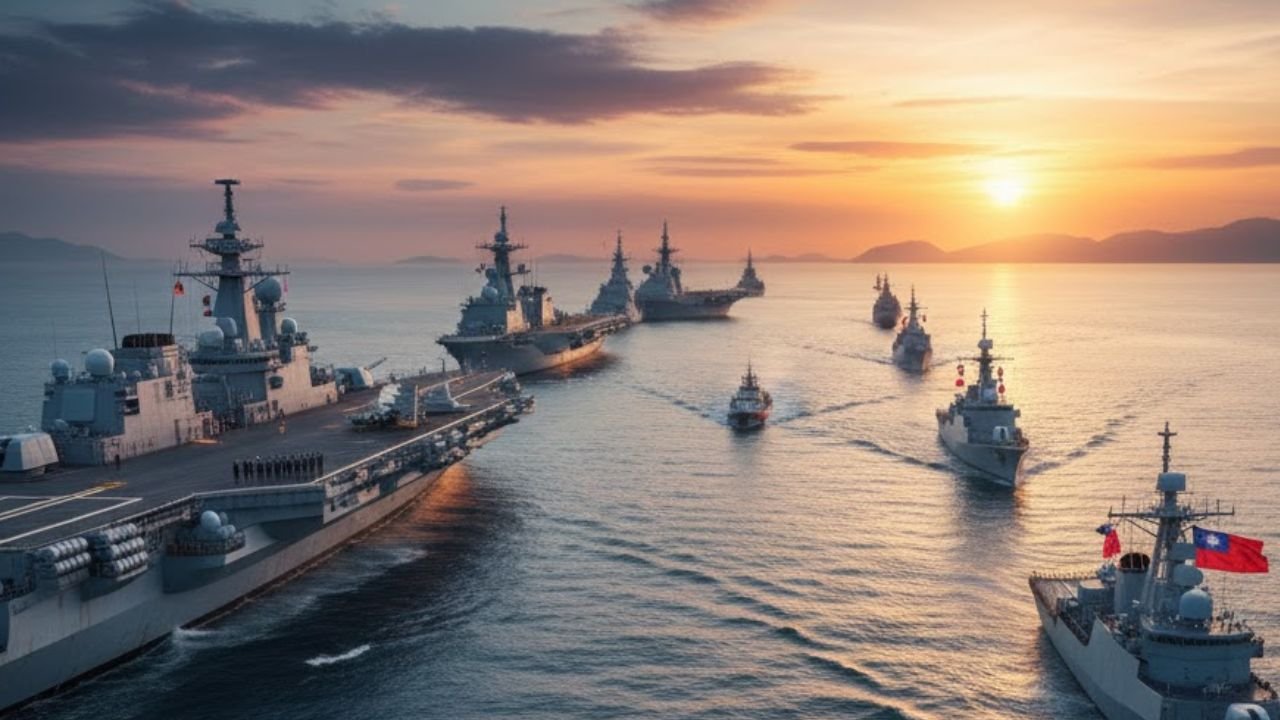
The Chinese Taiwanese Naval Standoff has become one of the most dangerous flashpoints in the world, pulling major powers into a long-running contest over sovereignty, security, and strategic control of the Western Pacific. The confrontation now includes constant military maneuvers, grey-zone tactics, and high-stakes diplomacy involving People’s Republic of China, Taiwan, United States, and Japan. What began as a regional dispute has evolved into a defining struggle shaping the future of the Indo-Pacific.
Understanding the Modern Chinese Taiwanese Naval Standoff
The current naval standoff is part of the ongoing Fourth Taiwan Strait Crisis, which escalated after US Speaker Nancy Pelosi’s visit in 2022. Since then, the People’s Liberation Army has intensified operations across the Strait, abolishing the long-respected median line and normalizing military pressure around the island. This new environment is defined by constant grey-zone warfare, large-scale blockade simulations, and increasingly assertive Chinese rhetoric about reunification.
Historical Roots and Escalating Tensions
The tension between China and Taiwan stretches back to the aftermath of the Chinese Civil War. But the latest phase emerged when Beijing began treating the Taiwan Strait as internal waters. The trend accelerated after Pelosi’s 2022 visit, when China launched its largest set of military drills since 1996. These drills included ballistic missile launches, encirclement maneuvers, and aggressive naval posturing that signaled Beijing’s readiness to pressure the island without committing to full-scale war.
By 2025, the standoff transformed into a sustained confrontation marked by record PLA deployments and elimination of political and military buffers that previously helped maintain stability.
China’s Expanding Military Strategy and Blockade Pressure
China’s approach to the standoff is driven by its goal to isolate Taiwan while discouraging outside interference. The late-2025 exercise “Justice Mission 2025” simulated a multi-point blockade around Taiwan, lasting ten hours and involving live-fire rocket launches into surrounding waters. Intelligence reports documented nearly ninety Chinese naval and coast guard vessels conducting area-denial operations, an unmistakable sign of China’s escalating pressure campaign.
The Eastern Theater Command, which oversees Taiwan-focused operations, expanded its presence by sending aircraft, warships, and rocket units deeper into Taiwan’s immediate maritime zones. In January 2026, a China Coast Guard vessel came within twenty nautical miles of Taiwan’s main island, breaking a long-held threshold and demonstrating Beijing’s intent to erase any remaining informal boundaries.
China aims to control the First Island Chain, positioning assets such as the Shandong aircraft carrier and H-6J naval bombers to prevent outside military intervention, especially from the United States and Japan.
Admiral Tang Hua and the “Anaconda Strategy”
Taiwan’s Navy Commander, Admiral Tang Hua, described China’s pressure campaign as an “Anaconda Strategy”, a slow-strangulation effort designed to weaken Taiwan’s defenses without direct conflict. PLA aircraft crossing the former median line surged dramatically, rising from thirty-six incursions in early 2024 to nearly two hundred by August of the same year.
These constant intrusions force Taiwan to deploy nearly half of its operational fleet just to monitor foreign vessels and aircraft, increasing maintenance burdens and stretching manpower. This slow, grinding pressure is a core element of the Chinese Taiwanese Naval Standoff and keeps Taiwan in a perpetual state of high alert.
Taiwan’s Defense Transformation and Naval Modernization
While China expands its military presence, Taiwan is undergoing its most significant defense overhaul in decades. The government has launched a Light Frigate Program, developing ten modern 2,500–3,000-ton ships designed for anti-air and anti-submarine missions. The domestically built Narwhal-class submarine conducted testing off Kaohsiung in 2026, marking a breakthrough for Taiwan’s naval independence.
Taiwan has also created a Littoral Defense Force, integrating fast attack boats, missile craft, and the Haifeng Brigade, which operates HF-2 and HF-3 anti-ship missiles. The HF-3, with its 400-kilometer range, forms the core of Taiwan’s Decisive Sea Battle doctrine, an asymmetric strategy aimed at deterring superior Chinese forces through precision strikes.
On land, Taiwan continues integrating US-made systems, including the final shipment of M1A2T Abrams tanks, expected in early 2026. Despite internal political disagreements, Taiwan’s modernization efforts reflect a national push to remain resilient in the face of mounting maritime pressure.
United States Support and Strategic Ambiguity
The United States remains Taiwan’s most important security partner. In December 2025, Washington approved a record $11.1 billion arms package, which included HIMARS systems, Altius drones, and Javelin missiles. These weapons significantly strengthen Taiwan’s ability to counter amphibious and blockade threats.
Yet in early 2026, Washington released its National Defense Strategy without explicitly mentioning Taiwan, creating uncertainty among Taiwanese officials. The February 2026 phone call between Donald Trump and Xi Jinping further highlighted the complexity of American policy, as Xi warned the US to act “prudently” regarding arms sales and military involvement.
Japan, the Quad, and the Indo-Pacific Security Network
Japan has grown increasingly concerned as Chinese missiles have landed in its Exclusive Economic Zone. Statements from Japanese officials suggesting possible military involvement in a Taiwan conflict triggered strong protests from Beijing. The situation has widened beyond a bilateral dispute, drawing in countries such as Australia and India through the Quad alliance, which supports a “Free and Open Indo-Pacific.”
Japan’s direct involvement or coordination with the US in the First Island Chain would significantly reshape the Chinese Taiwanese Naval Standoff, turning it into a broader Indo-Pacific security crisis.
Grey-Zone Warfare: The New Normal in the Taiwan Strait
The standoff has evolved into a continuous cycle of grey-zone activities. China regularly deploys coast guard ships, maritime militia vessels, and unannounced naval patrols near Taiwan’s 24-nautical-mile contiguous zone. These operations blur the line between peacetime and conflict, keeping Taiwan under pressure while avoiding outright war.
Taiwan’s response includes counter-patrols, enhanced radar coverage, public readiness drills, and expanded naval deployments. Grey-zone activity now defines the rhythm of the Chinese Taiwanese Naval Standoff and sets the stage for more aggressive actions if tensions continue to rise.
Final Thoughts
The Chinese Taiwanese Naval Standoff is no longer a temporary crisis but a structural conflict shaping the Indo-Pacific’s future. China relies on escalating military pressure, blockade simulations, and grey-zone tactics, while Taiwan strengthens its navy, missile networks, and asymmetric capabilities. The involvement of the United States, Japan, and the broader Indo-Pacific community adds layers of complexity that turn this regional dispute into a global security concern.
As the standoff intensifies, one miscalculation could shift the crisis from strategic pressure to open conflict, making the Taiwan Strait one of the most important geopolitical flashpoints of the decade.
FAQs
What triggered the latest Chinese Taiwanese Naval Standoff?
The standoff accelerated after Pelosi’s 2022 Taiwan visit, which provoked major PLA drills and the abolition of the median line, leading to continuous military pressure.
Why does China focus on blockade simulations instead of invasion?
Beijing prefers slow isolation strategies like the “Anaconda Strategy,” which avoid the risks of a full invasion while still weakening Taiwan.
How is Taiwan responding to China’s military pressure?
Taiwan is modernizing its navy, deploying HF-3 missiles, expanding its submarine fleet, and strengthening coastal defense forces.
What role does the United States play in the standoff?
The United States provides major arms packages, conducts naval operations, and supports Taiwan’s defense development, though its strategic intentions remain ambiguous.
Why is Japan increasingly involved in the Taiwan Strait situation?
Chinese missile activity near Japan and concerns over regional security have pushed Tokyo into a more active role, especially through cooperation with the US and the Quad.